
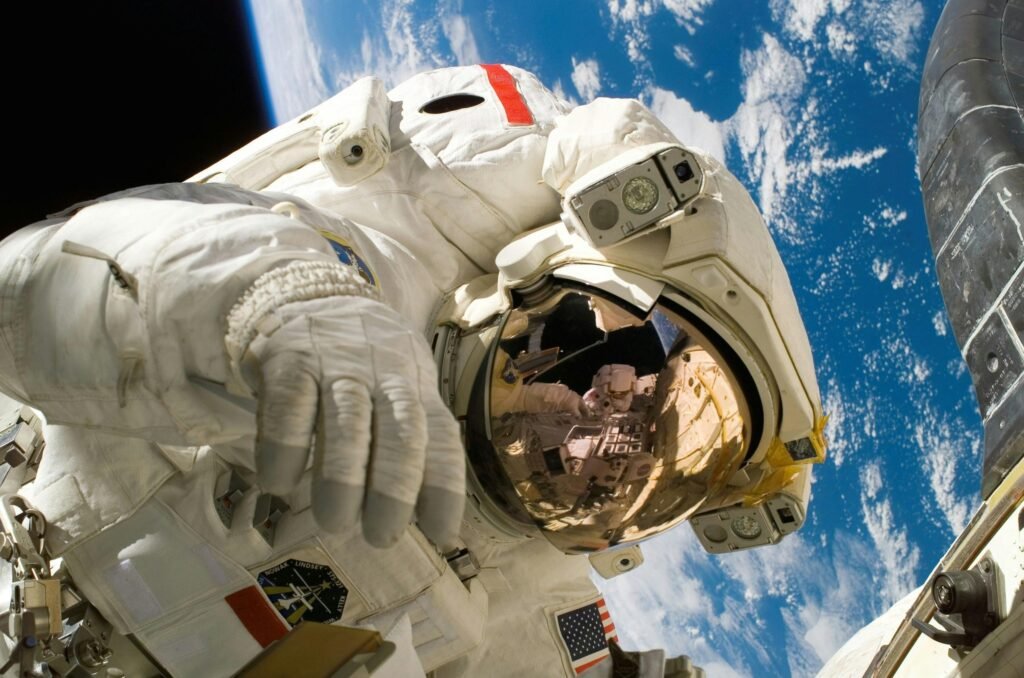
1. Artemis II Becomes A Historic Moment in Human Spaceflight
The space sector will soon embark on another monumental moment: NASA’s upcoming Artemis II Program, the first time humans will have orbited the Moon since the Apollo missions more than 50 years ago.
Prior to this mission, there has been an extensive testing program for the rocket (the Space Launch System [SLS]), including several recent “wet dress rehearsals” in which fuel loading and final countdown procedures were carried out to confirm the readiness of the vehicle for launch. The Artemis II Mission is scheduled for launch no later than March 2026 and represents a major transition from conducting robotic missions to establishing a long-term human presence beyond low-Earth orbit (LEO).
The Artemis II astronauts will fly to the Moon via a crewed Orion spacecraft launched atop the SLS for a ten-day period and will continue mankind’s descent into deep space that originated with the Apollo missions.
This mission is a demonstration of technological capabilities but is also a key milestone on the path to Artemis III, which is planned to have humans land on the Moon’s South Pole.
2. Robotics, AI, and Mars Exploration
The autonomous location detection capacity of NASA’s Perseverance rover on Mars has been established through the robotic exploration of Mars with respect to its use of novel, autonomous, and on-board algorithms to establish its position without the use of any direct Earth reference. The use of a Mars Global Positioning System has allowed for the rover to determine its own position in its ability to autonomously navigate its way around the Martian surface.
In addition, many of the most recent science missions are utilising AI/automation technology for both navigation and planning science activities, as well as being able to manage communication latency over the vast distance of interplanetary space (i.e., Mars to Earth).
The advancements in technology and the advancements in how nations and space agencies prepare for more extended robotic missions and the possibility of human exploration of the surfaces of Mars and the Moon will be essential to the success of these space missions in the future.
3. Growth of Commercial Space and Satellite Infrastructure
The space industry is growing significantly. Government-funded projects are not the only area where this is taking place. Similar growth has occurred at commercial space technology companies.
As a recent example of this commercial growth is Setanta Space Systems, which launched as an Irish-based space technology business that provides advanced satellite solutions for various applications including earth observation, space situational awareness, etc…
Thailand’s recent launch of its satellite KNACKSAT-2 also serves as a good example of a country joining in the on-going global growth of space-based research by launching its own satellite into orbit.
There are also new trends in the type of investments being made into space infrastructure as a result of both national defense and indigenous interests in establishing sovereignty over space-based assets. For instance, the NATO Innovation Fund has recently approved £30 million (approximately $40 million) to support the UK’s SatVu satellite system in developing new methods of creating high-resolution thermal imagery for security, surveillance, and scientific monitoring uses.
In addition to the growth of commercial and government-sponsored satellite programs, satellite communications networks continue to play a vital role in the expanded global economy of space as an essential, enabling infrastructure for the continuation of new systems and services to enhance global connectivity and situational awareness for everyone on earth and beyond.
4. International Spaceflight Efforts: Astronaut Missions and Collaborating with Others
The pursuit of space exploration will continue to grow on an international level. The most recent example was French astronaut Sophie Adenot, who flew into orbit in early 2026, making her the second female French astronaut to fly in 20 years. She is presently working on the International Space Station (ISS) and is involved in hundreds of scientific experiments, including both biological and Earth-based.
As part of its effort to reflect these new technologies, NASA announced that astronauts can now bring their personal phones to space so they can document their time in space and send high-quality photos back to Earth.
These examples demonstrate how international collaboration, scientific exchange, and operational flexibility are informing the development of long-range human space exploration missions.
5. Reusable Launch Systems: SpaceX’s Technology
The commercial sector’s launch industry has continued to see advancements in technology. Recently, SpaceX successfully landed a Falcon 9 booster back in The Bahamas for the second time.
This landing evidences SpaceX’s operational flexibility with their booster recovery and has opened up possibilities for recovery operations to support multiple orbital trajectories. The Falcon 9 booster has now flown a total of 26 times. This number indicates that the Falcon 9 is both reliable and reusable.
The continued development of reusable launch vehicles will significantly reduce launch costs and increase the frequency of launches to orbit. This will create greater opportunities for the expansion of satellite networks, the establishment of commercial space activities, and for future exploration of deep space.
6. Celestial Events and Astronomical Phenomena
Natural celestial events have always interested people and scientists. On February 17, 2026, a dramatic annular solar eclipse will create a “ring-of-fire” effect which will allow it to be seen in regions of Antarctica and partially in southern Africa and South America.
Aside from visible events, astronomers are also following the paths of several bright comets that will be visible this year, creating potential opportunities for scientific study and public outreach.
NASA and the European Space Agency are currently planning to launch new space-based telescopes and observatories that will allow humanity to further explore our universe through many different wavelengths.
7. Upcoming Space Science Missions
There are some exciting new missions being launched and coordinated between the European and Chinese research efforts expected in 2026 and beyond. The Solar Wind Magnetosphere Ionosphere Link Explorer (SMILE) will explore how the solar wind interacts with the Earth’s magnetic environment.
NASA’s Nancy Grace Roman Space Telescope will launch in October 2026 and perform wide-field IR surveys of the Universe and contribute to the discovery of exoplanets and dark energy.
These platforms will grow our understanding of space weather, cosmic origins, planetary systems, and fundamental physics.
8. Strategic and Scientific Issues to Resolve
While technology is advancing quickly; there are still significant challenges to be overcome. Timing missions can be impacted by launch scheduling and engineer constraints (e.g., weather delays preventing fuel testing), which could push major mission (e.g., Artemis II) back significantly.
Additionally, as more satellites and debris are placed into orbit, there will be an increasing need for international cooperation and regulatory frameworks for maintaining safe access and sustaining operations in Low Earth Orbit (LEO).
Conclusion: Space in 2026
In 2026, the space environment will be bogged down with enhanced levels of diversity and access to space. Within the past 4 years, over a dozen private companies have entered the commercial space industry, creating unprecedented levels of access to space, from human exploration of Space to autonomous robotics exploring Mars.
Collaboration between governments and private industries, multinational scientific partnerships, and innovation will be the cornerstones of this era, as we move towards a sustainable human presence on the Moon or deeper into the solar system.
As we approach the launch of Artemis II, we now have autonomous robotic spacecraft exploring the outer reaches of the solar system and new satellites that will advance our ability to observe Earth and communicate with each other. We are at the threshold of an exciting new frontier of what we believe space exploration can be through visionary ambition, investment strategies, and curiosity.