
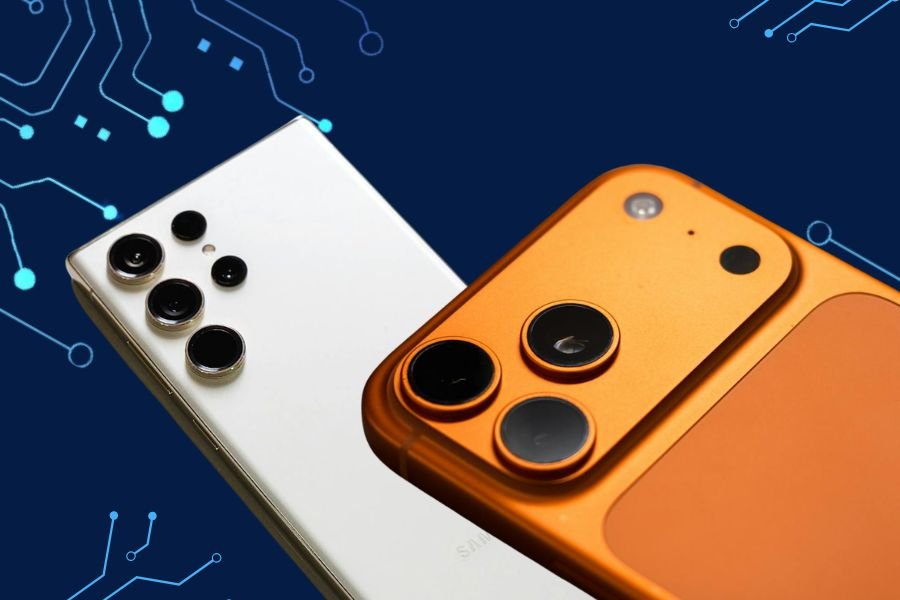
The iPhone will be 17 years old by 2025-2026 and will compete against the Galaxy S26 Ultra, thereby continuing the ongoing competition between Apple and Samsung as leaders in mobile technology. Both have devices designed for power users who demand maximum performance, an exceptional amount of camera quality, as well as top-notch usability – not to mention both feature cutting edge technological advancements that will not become obsolete for many years to come (future-proofed).
While they are both top-of-the-line phones, Apple and Samsung have very different philosophies regarding what to do to get there. The article examines their respective advantages/disadvantages over the most important factors when determining which phone is right for you, providing the comparison of how the two compare on all criteria.
Appearance and Size: Minimal vs Maximum Space
The first thing you will notice when comparing an iPhone 17 with a Galaxy S26 Ultra is how they both feel differently in your hands.
Build Quality and Style
– The iPhone 17 is designed with an elegant minimalist aesthetic, using a premium aluminum and ceramic shield glass to achieve a very lightweight feel while still looking classy. The smaller size (under 150mm tall; approx. 177g) also makes it easy to use one-handed without sacrificing any of the display’s quality or capabilities.
On the other side of the coin, the Galaxy S26 Ultra has a larger and heavier design, with a 6.9″ display made from premium glass and constructed with either titanium or aluminum depending on which country it is sold in and which version you purchase. Because of the larger size, you have a more substantial phone in your hand, with a stylish look and narrow bezels. You also have the option of using the included S-Pen stylus to help you be productive, where you cannot do this with an Apple device.
Display Technology
– For years, Samsung has led the pack with the best displays available on the market, and the S26 Ultra only continues this tradition. The S26 Ultra’s Dynamic AMOLED 2X panel has a much higher resolution (~3120 x 1440), pixel density, and likely support for a refresh rate up to 144Hz depending on your display settings, making everything from scrolling to gaming to multimedia feel like an immersive experience.
It features a beautiful Super Retina XDR OLED display with a 120 Hz refresh rate (with peak brightness up to 3000 nits), great for use in bright environments and showing off vivid colors. It does come with a lower resolution compared to its closest competitor, the Samsung Galaxy S26 Ultra; however, the way that Apple has designed its display priorities natural color accuracy, making it great for both standard video and HDR content.
All in all, if you are looking for a larger, sharper display (and/or enjoy watching movies or using multiple apps at once), then the Samsung Galaxy S26 Ultra is your best bet. But if you prefer a pocket-sized device with rich color reproduction, then you may find the Apple iPhone 17 to be visually pleasing.
Both the iPhone 17 and Samsung Galaxy S26 Ultra have many similarities, such as an emphasis on excellent performance and software, making them two of the strongest contenders in this industry. Both companies place heavy penalties on the amount of battery life remaining before charging; therefore, the ability to perform at their respective jobs for longer periods of time will give an advantage to whoever has the highest performing devices.
The performance of both devices is undoubtedly going to be one of the most important factors in how well they compete against each other.
Internal Powerhouses:
The Apple iPhone 17 has an A19 processor (customized Apple silicon) chip that provides a high level of performance for a variety of applications running iOS to be smooth, responsive & efficient in their day-to-day use; thanks to the enhancements made by Apple through software optimization on their products. Apple’s optimizations generally allow for users to utilize their products more efficiently than other manufacturers based solely on the raw specification.
The Qualcomm Snapdragon 8 Elite Gen 5 (Exynos 2600 in certain areas) mobile platform, which the Samsung Galaxy S26 Ultra uses, enables smooth multitasking, console-quality gaming and multiscreen performance for this flagship device. In the majority of multi-core and graphical benchmark testing, it has outperformed many of the other Android flagship smartphones. The additional memory allows users to run multiple applications at the same time or multiple applications and processes in the background over an extended period of time.
Overall User Experience
The software experiences offered by the two phones, however, represent two distinct philosophies:
The iPhone 17 (iOS) offers a streamlined and cohesive experience that delivers firmware updates much faster than the S26 Ultra. iOS also delivers extremely deep integration with the Apple family of products, including iCloud, MacBooks and Apple Watch as well as ease of use through design.
The Samsung Galaxy S26 Ultra’s Android 16 OS with Samsung’s One UI provides extensive options for modifying the software to meet the user’s own preferences allowing for complete control of all settings and providing features such as the DeX desktop and advanced multi-tasking.
The iPhone 17’s operating system is focused around simplicity and having a cohesive interface throughout all applications and across all iOS devices while the S26 Ultra operating system is designed to give power users flexibility and customized features. Ultimately, which operating system you choose to use may depend on how entrenched you are in either ecosystem.
Camera Systems: Consistency of Color vs. Versatility with Zoom
Camera performance often weighs heavily into customer decision making when buying a premium phone, and here both phones take distinct approaches.
Apple’s Dual Camera System
The standard configuration of an iPhone will include two rear-facing 48 MP cameras — a regular camera and an ultra-wide camera. Apple utilizes computational photography to produce photos with realistic color representations, accurate skin colour rendering, and dependability in different lighting environments. Apple also has a reputation for producing amazing video quality with regard to stability and HDR performance.
Samsung’s Quad Camera Systems
The Galaxy S26 Ultra goes even larger by including a quad camera system with a 200 MP primary sensor, and multiple telephoto sensors with optical zoom capabilities as well as wide-angle and ultra-wide-angle view modules. This configuration allows the Ultra to have a significant capability for capturing very large amounts of visual information in an individual image, particularly when photographing objects at a distance when Apple is unable to match the level of detail. Samsung also takes advantage of advanced AI-based methods to increase the quality of images either automatically or through on-device creative adjustments.
Based on performance alone it is clear that the Samsung camera system provides a large degree of versatility when compared with Apple’s camera technologies. However, Apple’s computational photography will frequently produce more uniformly natural images for a larger number of users without requiring them to make manual adjustments to their camera’s settings.
Front Cameras
The adjustable front camera of the iPhone 17 tends to have a higher resolution when taking selfies, which results in clear images of yourself where your skin tone is as expected. While the Samsung front camera may not compete directly with Apple for ultimate sharpness, Samsung combines strong software, including advanced portrait effects, with nuanced hardware to deliver an overall high-quality experience for users.
Battery & Charging: Big Battery, Even Bigger Differences
Whether it is a phone helping someone work long hours away from home, or helping someone just surf the web while riding a long train-ride and therefore will require significantly more battery power than an average phone user.
For the Samsung Galaxy S26 Ultra model, the phone packs a large-capacity 5000 mAh battery and will provide great battery life under continuous use for at least 1 full day without having to recharge. The phone supports fast USB-C charging and can be charged using either telephone or computer charger at 60W charging speed using the USB-C port, or use a fast wireless charger that supports fast charging at 25W. While it’s an improvement over its predecessors, it still falls short than what other manufacturers are offering.
The Apple iPhone 17 is powered by a smaller, roughly 3690 mAh battery, and has been engineered to be very effective at using battery life by utilizing lower-power chips and battery-saving software, thus allowing for 1 full day of normal usage. The phone has a good 40W maximum for wired charging via USB-C port, using MagSafe technologies can allow for multiple forms of charging at home with appropriate MagSafe accessories.
While Samsung offers a larger battery and faster charging, Apple’s efficiency means when using either phone the available battery life for the comparative users is often close.
Pricing and Value of Flagship Features
Flagship phones usually cost a great deal and both the iPhone 17 and Galaxy S26 Ultra definitely fit that bill. But in regards to actual MSRP, the iPhone 17 has a dramatically lower base price which makes it far more accessible to a larger audience than the S26 Ultra. The S26 Ultra also has an exceptionally high list price because of all of its advanced hardware, larger display and innovative camera technology.
In addition to their cost, value must also be considered based on what benefits the different ecosystems offer. For example, when buying an iPhone, you will receive long-lasting software updates for many years, as well as seamless integration between all your Apple products. With Samsung, you will receive hardware flexibility, a multitude of great features and will have access to the Android platform for years to come.
In conclusion, both iPhone 17 and S26 Ultra are amazing smart phones; however, each is made for a different person.
If you like small-size phones with a good ecosystem, a great user experience and can capture stunning video then choose iPhone 17.
If you want the highest performance, largest/clearest display, the most versatile camera and the most customizable phone possible, then choose Samsung Galaxy S26 Ultra.
Neither phone can be classified as “better”; however, each trades on its strengths in its own unique way. Understanding your priorities (performance, camera capabilities, form factor, ecosystem or value) will help you make your decision between the two flagship products.