
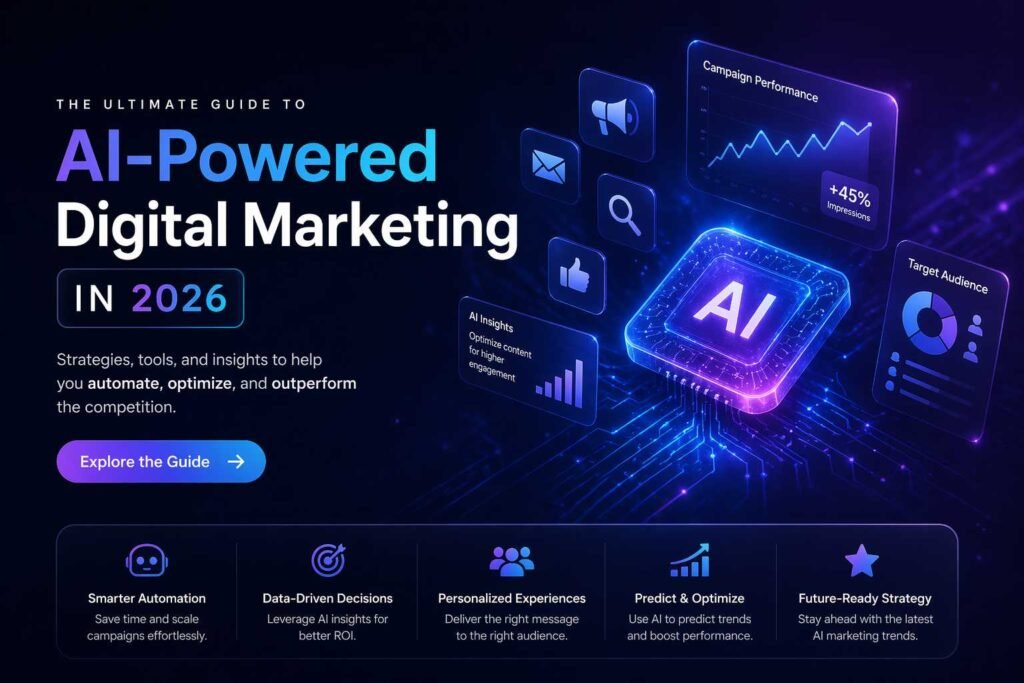
Digital Marketing
Digital Marketing has undergone significant changes due to AI (Artificial Intelligence) which was previously characterized as a manual, instinctive-based initiative; many see it as now a data-driven automated market ecosystem. In 2026, it will no longer be a competitive edge but must be an integrated element of any marketing strategy. Those brands who do not utilize Artificial Intelligence in their marketing strategy will be left behind when it comes to personalization, efficiency and engaging with customers.
This guide discusses how Artificial Intelligence is changing digital marketing, tools and strategies that will be critical to success in 2026 and how to position your business for success in this quickly changing environment.
How is AI Changing Digital Marketing?
AI is a term used to describe systems that utilize machine learning, natural language processing (NLP), predictive analysis and automated technologies to provide marketers with better ways to optimize their efforts. These systems evaluate and analyze large data sets, recognize trends and patterns, while making accurate decisions in a fraction of the time it would take a person to do so.
Benefits of Using AI for Marketing
Ability to Analyze Large Amounts of Data: With Artificial Intelligence, marketers can analyze large amounts of data very quickly, this gives marketers insights that could have taken weeks or months to gather without the use of Artificial Intelligence technology.
Forecasting Potential Customer Behavior and Resulting Actions: By using predictive analysis, marketers are forecasting customer behaviors, trends and developing insights on how existing and future campaigns will perform.
Automated Marketing Functions or Processes: There are many repetitive marketing tasks (i.e. email scheduling, ad placement and customer segmentation) that the use of Artificial Intelligence will perform automatically.
Personalization of Content, Recommendations and Messaging: With the use of Artificial Intelligence, content, recommendations and messaging will be tailored to the individual customer.
AI Marketing in 2026: Core Principles
1. Hyper-Personalization
The original concept of personalization included inserting names into emails. Now personalization is a fully dynamic user experience, with artificial intelligence analyzing user browsing, purchase history, and real-time interactions to provide relevant content.
Examples:
Web page layout and messaging change based on the individual visitor
Real-time product recommendations
Email generation is unique to the individual recipient
End result: More customer engagement, higher conversion rates, and greater customer loyalty.
2.AI Content Creation
Content still rules; however, now AI is co-creating content. Blog posts, video scripts, and other items of content can be produced by marketers with assistance from AI-powered tools that deliver high-quality content at rapid speeds.
Examples of AI Content Benefits:
Developing ideas based on trending topics
Automated SEO optimization for all content
Adjusting tone and style of content for various target audiences
Automatic translation of content into multiple languages
In all instances, it is extremely important that the human touch remains in creating authentic and successful brands.
3.Predictive Customer Journey Mapping
AI no longer merely responds to customer interactions; it now anticipates future behavior of the customers. By analyzing customer data generated during online interactions, companies will now be able to assess what stage of the purchasing journey a user is in, and can develop appropriate materials to motivate that specific customer to proceed to the next phase of their journey.
Applications
Finding potential high-value leads prior to their conversion
Reaching out to individuals with personalized offers at exactly the right moment
Reducing customer churn by detecting warning signs in advance
Through proactive marketing, marketers can step in and intervene at just the right time.
4. Conversational Artificial Intelligence and Chatbots
The chatbots of 2026 have evolved dramatically over earlier versions of chatbots as they have the capabilities to understand context, emotion, and intent – thus allowing for greater human-like interactions.
Key Features
Providing 24/7 customer support with nearly human-like accuracy
Seamless transition to human representation as needed
Full integrations for text and voice across all platforms
Personalized response options based on the user’s previous interactions
These systems provide greater levels of customer satisfaction, while simultaneously helping to decrease the costs associated with operating these systems.
5. Artificial Intelligence-Powered Ads
Artificial Intelligence has made advertising more effective and precise than it was previously. Platforms are now able to use machine-learning capabilities to ensure that their ad targeting; bidding and creative may be adapted in real-time.
What Has Changed
Automated A/B Testing for Ads
Real-Time Budget Allocation Across Multiple Channels
Audience Targeted Based on Behavior Rather Than Just Demographics
Dynamic Creative Advertisements That Change for Each User
Therefore marketers may now achieve a higher Return on Investment (ROI) and productivity with less manual input.
Essential Artificial Intelligence Tools and Technologies
Machine Learning Tools
These tools can analyze and learn from historical data, thereby allowing marketers to make more effective and efficient business decisions.
Natural Language Processing (NLP)
Artificial Intelligence can generate and understand the English Language. The implementation of this technology has led to the creation of chat-bots, creation of content tools and making it possible to do sentiment analyses.
Computer Vision
This technology enables the ability to analyze images and video, to provide the ability to perform visual searches, make your advertisements more efficient, and analyze user created content.
Marketing Automation Platforms
Modern Marketing Automation Platforms leverage Artificial Intelligence to automatically help you manage your Marketing Campaigns, Segment Your Audience into distinct groups and automatically track Performance.
Creating an AI Marketing Strategy
1. Identify Specific Measurable Goals
Identify what you want AI to achieve, whether it be Increased Conversions, Improved Customer Retention or Decreased costs.
2. Collect and Organize Data
Your artificial intelligence’s effectiveness is based solely on the data it is trained on. You will want to ensure that your data is clean, organized and easily accessible before starting your efforts.
3. Select Appropriate Tools
You will want to use Tools that support your Goals and can integrate into your existing systems.
4.Continuously Experiment and Improve
AI is an experimental function and should be continuously tested with the results analyzed to refine your approach.
5.Incorporate Human Review of Results
While AI can perform many marketing actions on its own, human creativity and ethics will need to work together with AI in your marketing strategy development.
Challenges and Considerations
Ethical Use of Data and Compliance
The increase in the use of data requires marketers to develop the ability to follow the rules and ethical business standards or face potential consequences.
Excessive Automation Leads to Generic User Experience
If too much automated content is generated with no creativity, the user experience becomes generic. The role of balancing the AI efficiency has to be how the human’s creativity fits into the equation.
Human Resource Gaps
In order for teams to effectively utilize AI tools, all members of the team need to know how to effectively work using these tools. The investment in training on these tools should happen.
What is the Future of Artificial Intelligence within Digital Marketing?
Looking to the future, expect to see more comprehensive integration of AI within marketing ecosystems. Additional items that you can expect to see:
- Total automation of the running of marketing campaigns
- AI systems which exhibit an enhanced sense of emotional intelligence
- Greater integration than has existed; across all platforms and devices
- Enhanced voice and image searching ability
Marketers will shift from executing marketing to developing strategies for creative content creation, storytelling, and ethical decision making.
Final Thoughts
Speed, accuracy, and personalization will be how AI will define digital marketing in 2026. If companies incorporate AI within the digital marketing strategy can have better customer experience, better decision making and higher return on investment.
However, leveraging the benefits of AI will be reliant on how well you utilize the tool itself, this means that the use of these tools in a thoughtful manner will yield positive results. The best uses of AI will come from leveraging the analytical abilities of AI with the creativity and empathy found within marketers.
By becoming informed on the tools, trends and best practices identified within this guide you can position your brand for successful implementation of digital marketing in today’s digital climate.