
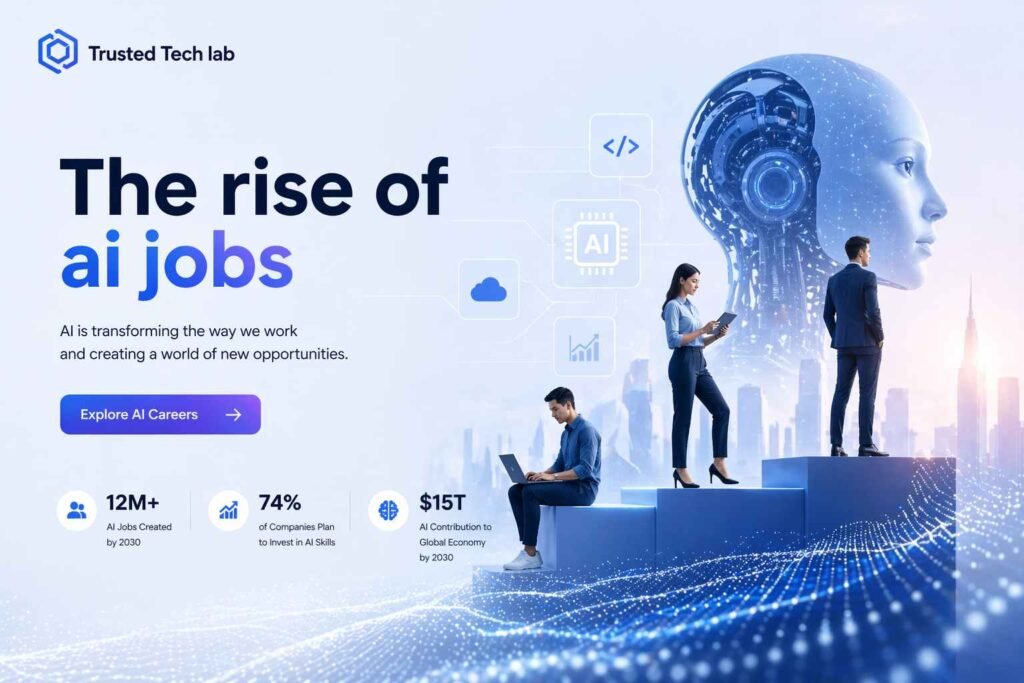
AI Jobs
Artificial Intelligence (AI) is no longer a sci-fi fantasy, but rather has become an influencer that is transforming how industry, economy and work are conducted. More companies are utilizing AI technology to improve performance, decrease costs and provide a competitive advantage. As a result, we now see many new career paths opening up as companies develop and utilize AI technology. These new career paths will be technical, but also include creative, strategic and ethical positions, illustrating how AI is having multiple impacts on our world today. The emergence of new AI careers represents a large-scale shift in the global workforce that offers new opportunities and challenges for workers from all types of industries.
AI Jobs Growth AI Across All Industries
The growth of AI has not only happened within the traditional tech market, but rather AI has been implemented across nearly every business sector. Various industries such as healthcare, finance, education, retail, manufacturing, and even agriculture, are increasing efficiencies as well as productivity through the use of AI. For example, in healthcare, there are AI systems that can assist physicians in diagnosing illnesses and individualizing patient treatment. In finance, there are algorithms that can analyze market data, in order to assist financial institutions in detecting fraud. Retailers can use AI to predict the purchasing behavior of their customers and make educated purchasing decisions.
Due to the increasing demand from businesses to develop, implement, and manage AI systems, AI jobs have expanded beyond just software developers, and include a variety of career opportunities.
AI has created many new job opportunities
different locations around the world, which means there will be a lot of different opportunities for many new job roles such as:
AI Engineers
To build and put in place, or deploy, an AI solution requires the skills of an AI engineer. They create AI solutions based on machine learning algorithms and constructs such as neural networks, deep learning, etc. and require a high level of knowledge in computer science, mathematics, and programming.
Data Scientists
Many data scientists have contributed to the development of AI. They analyse large volumes of data to find relationships/insights, build models that are predictive or descriptive, and ultimately create the basis for AI solutions by providing them with the data required to operate.
Machine Learning Specialists
Machine learning specialists are only focused on building the algorithms that allow an AI solution to continuously learn, improve, and change its characteristics through time without explicit programming. They work to “tune” models and improve performance.
AI Ethics Specialists
With the increasing power of AI comes with an increasing number of ethical issues surrounding AI solutions. An AI ethics specialist addresses the ethical implications by ensuring that all AI solutions are built on the concepts of fairness, transparency, and accountability and are not biased. They’ll also address issues such as privacy of the data used to train an AI solution, algorithmic discrimination, and accountability.
Product Managers for AI
AI product managers play a vital role in bringing together the technical staff and the business aspects of AI-powered products. They are responsible for managing the entire development lifecycle of AI products, from inception to release, while ensuring that the product meets user requirements and satisfies the organization’s overall goals.
Key Skills Needed for AI Jobs
With the rapid growth of demand for AI professionals, there has also been an emphasis placed on specific skill sets needed by a professional working in an AI field. The technical skill set required for most AI positions is extensive and includes programming skills (Python, R), data analysis skills, and advanced knowledge of various machine learning frameworks and methodologies. However, the professionals that will succeed in AI careers will also need to possess many of the soft skills associated with traditional jobs. These soft skills include critical thinking and reasoning skills, problem-solving, communication skills, and adaptability.
Another important factor in the progression of AI careers is gaining additional knowledge through an interdisciplinary approach. For example, a professional working in the healthcare field must understand both medical terminology and regulations, whereas a professional working in finance should have some familiarity with basic economic concepts and compliance laws.
Education and Training in AI Careers
Many universities and online learning platforms have reacted to the increased interest of people wanting to pursue AI careers by providing a variety of programs specifically related to this burgeoning field, including certificate programs, degree programs, and multiple specialized courses. Today, it is common to see universities offering undergraduate and graduate programs specific to artificial intelligence, data science, and machine learning. Online learning platforms are allowing professionals who want to develop their AI skills to work at their own pace and on their own schedule.
In addition, Boot camps and shorter training programs have gained great popularity and provide hands-on experience with a realistic approach. These programs are especially advantageous for those who are interested in transitioning into AI and don’t have the time or money to commit to a long-term degree program.
Opportunities and Benefits
With the increasing number of jobs in the area of AI, there are many opportunities provided by this new wave of high-paying jobs associated with AI. Many of the jobs related to AI also offer a greater level of job security as well as career advancement opportunities. There are many high-paying job openings in AI-related fields, and there are a large number of people looking for these types of positions.
Furthermore, the rise of AI provides people in this field the ability to work on the latest technology and apply their skills to help solve some of the most complex problems facing our society today. Whether developing self-driving cars, producing better results for patients from medical care, or making things easier for people to access products and services, there are many ways that people working in AI can make positive contributions to our society.
Companies that invest in AI talent and have the resources to integrate AI into their organization can realize substantial increases in innovation, productivity, and effectiveness. Companies that implement AI within their organizations will have an advantage when it comes to meeting changing customer needs and market trends.
Challenges/Concerns
While there are many opportunities associated with the rise of AI jobs, there is also a great deal of concern regarding the possible loss of jobs associated with the use of automation and AI technology to complete tasks traditionally completed by humans. In addition, many employees fear they may lose their jobs to machines or computers since they may be able to complete the work that is done by humans faster and without the errors of human workers.
Numerous experts contend that AI will generate more jobs than it often replaces, especially areas where human creativity, emotional intelligence, and judgment are necessary. The challenge is how to reskill and upskill our current workforce so they can fill these new employment opportunities.
One other issue is ethical standards for using AI. Ethical examples of AI include data privacy, demographics, biases, and how to be accountable for using AI. Because of issues raised by ethical standards in AI use, it has become a government-supported initiative to develop governances and regulations for the ethical use of AI.
The Future of AI Jobs Opportunities
The future outlook for AI jobs opportunities is promising and projected to grow. Emerging technologies such as generative AI technologies, natural language processing, and computer vision will continue to generate more job opportunities.
As AI (technology) continues to be integrated into our daily lives at an accelerating pace, the demand for individuals with experience in managing or overseeing AI-related systems and/or projects is rising. Hybrid job opportunities that require someone to possess AI expertise and industry-specific knowledge will be critical (in demand) as the demand grows.
In addition, human/AI collaboration is expected to shape the future workforce. Instead of replacing humans, AI will enhance human capabilities and allows us to accomplish our tasks faster and better.
Final Thoughts of Ai jobs
The emergence of jobs related to AI has caused a major change in how people work around the world. With advancements in AI technology, there are greater possibilities to create employment opportunities than in the past, as well as new challenges. Individuals need to continue to learn and to develop their abilities and skills related to AI’s development. Businesses must invest in and develop a workforce that is skilled in using AI and working with AI ethically.
In conclusion, the increasing number of AI-related jobs represents not just an area of technological growth, but it also involves changing how work is done, how innovations happen, and how society benefits from those innovations. Anyone who is able to adjust to this change will be able to thrive as AI continues to play a larger role in the world.