
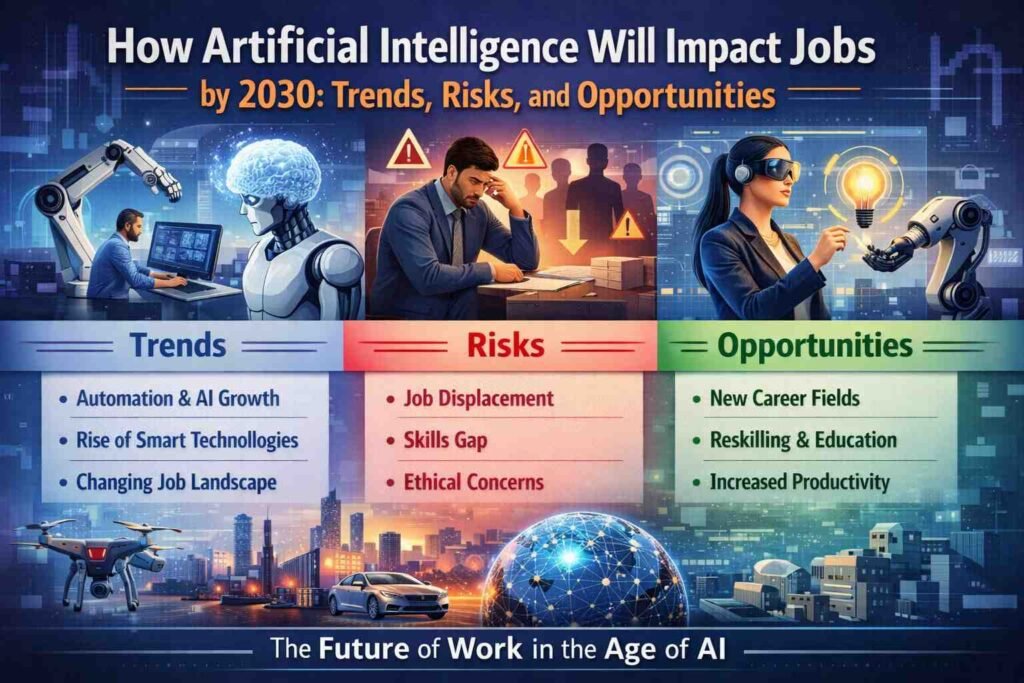
The Impact Of AI On Jobs By 2030
Artificial Intelligence has gone from science fiction to a reality. Continually evolving technology will enhance industries, redefine work, and transform the global economy. Businesses and individuals are already experiencing significant changes in how they conduct business (e.g., automated manufacturing, algorithmically finance), and by 2030, we will likely witness an exponential rise in the impact AI will have on jobs; this will lead to both excitement as well as concern over this advancement’s effects on employment levels.
Will Artificial Intelligence replace our jobs? Or will we see a net job loss as a result of AI entering the marketplace? The answer lies somewhere between these two extremes. Our working future will focus not only on losing or gaining jobs but rather on the transformation of existing work. Some jobs will be changed; new jobs will be generated; and some skills that were required for current jobs may not necessarily be necessary once we begin using artificial intelligence in our workplace.
Research performed worldwide indicates that approximately 92 million jobs could be eliminated because of Artificial Intelligence; however, at the same time, there will be an increase of about 170 million jobs created as a result of using Artificial Intelligence by 2030. This means that ultimately, there could be a net increase in jobs created from the use of AI leading to greater job creation than job losses due to the potential for very disruptive changes to current systems.
Given this complexity, there are no easy answers regarding Artificial Intelligence’s future role in our job market.
Through this article, you will learn about how AI will affect jobs by 2030, which industries are likely to be heavily impacted by job losses, new types of jobs that may be created as a result of AI, what skills will be demanded for those jobs, and how you and your organization can prepare for changes associated with those developments.
The Future of Automation in Our Workplaces
We see the application of automation in so many different areas today. Machine learning is being used to evaluate large amounts of data, automate mundane tasks, and help make better decisions for businesses. Chatbots, robotic process automation (RPA) and generative AI are now commonplace at work.
Currently, it is estimated that 30% of jobs will be fully automated by 2030; and with an additional 60% of jobs being significantly changed by AI, most of the current workforce will not completely lose their jobs but instead will see their jobs transformed by the inclusion of AI technology.
Furthermore, as we move toward an increase in the interaction between humans and machines; by 2030 it is projected that output will be divided more equally between our outputs as humans, as well as through machine output, and through our combined efforts as humans and machines. The expectation is that the movement will progress from total automation to automation (augmentation), and more and more automated tasks will be enhancements of human capabilities instead of total replacements of tasks performed by humans.
Jobs To Be Most Impacted By AI
Repetitive/Routine Jobs
The current jobs that are most vulnerable to automation will be those that are repetitive/routine and predictable. Automated systems are larger (i.e., capable of processing more structured data) and faster than people; e.g., processing structured data faster than the current average time it takes for an employee to input their data into the automated systems and to input data into the current supply chain.
Examples:
Data Entry Clerk
Call Counter and Customer Service Rep.
Cashier, Tellers
Administrative Assistants
These types of jobs are frequently characteristically of the nature that would be standardized therefore would lend themselves to being targeted for automation.
Low Entry Level White Collar Jobs
AI is becoming very capable of performing cognitive tasks such as document review, basic programming and legal research which poses a threat to many entry-level white-collar jobs.
it has been reported that automation is likely to disrupt a large number of entry-level positions across all industries. The decline of these jobs may have adverse long-term consequences to job creation in the long term because the majority of entry-level jobs serve as a means of advancing to higher-paying employment opportunities.
Manufacturing & Logistics
Automation has been occurring in manufacturing for many years and AI is aiding that trend. Today, AI-powered robots are capable of performing very complex tasks in manufacturing, such as quality inspection, assembly and inventory control.
Similar to manufacturing, AI is also transforming the logistics sector. Logistics companies use AI-based systems to optimize transportation and inventory processes and operate self-driving vehicles. As a result of automation in these sectors, jobs are being displaced or redefined.
Jobs That Will Expand and Prosper
Technology/AI Related Jobs
The exponential growth of technology and adoption of AI will result in an increased demand for qualified individuals in technology. The following positions are some of the fastest growing occupations:
1) AI/Machine Learning Developers
2) Data Scientists & Data Analysts
3) Robotics Engineers
4) Cybersecurity Professionals
Roles are critical for designing, developing, supporting, and enhancing AI systems.
Occupations with a human center.
Jobs requiring emotional intelligence, creativity, and interpersonal intelligence are much less likely to be done by machines than other types of work and include:
Healthcare workers, such as nurses and therapists.
Teachers and instructors.
Social workers.
Creative professionals, such as writers and designers.
AI can assist in these fields (e.g., predictive diagnostics), but cannot fully to replicate the empathy and creativity of people.
Green and Sustainability Jobs.
Moving toward a green/sustainable economy will create new job opportunities in renewable energy and green/sustainable development and through AI optimization of these industries. However, the knowledge and expertise of an individual will be necessary.
The Growth of Hybrid Jobs
What is a hybrid job?
Hybrid jobs merge tech-based skills and domain-based skills. For instance, a marketer may need to understand data analytics and the application of AI tools; or a healthcare professional may work with AI-powered diagnostic systems.
Collaborating with the Hybrid Job
In the future, the work environment will become increasingly collaborative, as humans and machines automate different portions of the work. Data processing and routine tasks will be performed by computers; where humans do human things that are more strategic, creative, or interpersonal.
The co-pilot economy is a term that describes the shift of AI technologies in the workplace to being an aide, rather than a replacement for the worker.
Skills for the Future
Technical Skills
To succeed within the AI-enhanced environment of the future, workers will need to obtain certain technical skills, such as:
- Ability to analyze data
- Programming and coding
- Fundamental understanding of AI/machine learning
- Digital literacy
These technical skills will be needed across nearly every industry—not just in technology related roles.
Soft Skills
In addition to developing technical skills, soft skills will also become much more important. These skills will include:
- Critical thinking
- Creativity
- Emotional intelligence
- Communication
These skills, which have a human focus, are difficult for AI to replicate and will continue to have value in the future workforce.
Continuous Learning
Along with the continual advancement of technological capabilities, workers will need to continually update their skill sets. Continuous learning will become an ongoing necessity for all workers; it will not be something that workers will have the option of pursuing.
Economic and Social Impact
Displacement of Jobs and Inequality
Although AI growth is predicted to generate more jobs than are lost, the transition could leave many people behind and increase inequality. Those left behind are likely to be employees in low-skill jobs that will no longer exist.
A significant number of people who lose jobs due to displacement may find it difficult to obtain similar replacement jobs at their current salary level; this will create additional economic difficulties.
Impact on Earnings
The introduction of artificial intelligence will likely have an effect on worker’s earnings as well. Workers with high qualifications will likely see their earnings increase due to the use of AI, while those employed in jobs that replace them through automation may experience stagnant or decreasing earnings.
Differences Across the Globe
Whether AI technology will change jobs for people in different countries will vary according to how well developed the country’s technological infrastructure is. Countries with a strong technological infrastructure will be more likely to benefit from the introduction of AI than countries with less developed technological infrastructures.
Government’s Role
The Government and private businesses need to provide employees with educational and job training programs that will prepare them for jobs in the new economy. The need for reskilling programs will be crucial to helping workers who were displaced by the introduction of AI into their industries.
Policy and Regulation
Policymakers must develop legislation and regulations to address issues like job loss, wage inequality, and ethical considerations regarding AI. Among these policies are measures designed to provide social nets for those who lose jobs, policies regarding wages in labor markets, and the development of AI governance.
Corporate Accountability
Corporate entities must take accountability for how they apply artificial intelligence to their business models, including but not limited to ensuring that their workers are treated fairly, providing employees with training and education related to the use of AI, and promoting the ethical use of AI.
Obstacles to Implementing AI
The introduction of AI will present many challenges to organizations and to employees, the primary challenge will be adapting to the rapid evolution of AI technology and keeping abreast of emerging technologies.
Gap in Skills
The gap between what skills workers possess and what employers seek is already noticeable. The gap will become even larger once AI is adopted.
Ethical Issues
AI raises significant ethical issues such as:
Algorithm bias
Privacy issues
Transparency in decision making
Addressing these ethical issues is key to gaining trust from people.
AI Providing Opportunities
Increased Productivity
Productivity through AI can be greatly enhanced through automating repetitive work, resulting in increased economic growth and standard of living.
New Industries
New businesses and industries will likely be created as a result of AI. For instance, there were already new opportunities in content creation, marketing and software development due to the generative AI trend.
Better Work-Life Balance
By removing many of the repetitive tasks, AI could reduce long working hours and give people the opportunity to be engaged in meaningful activities.
Future of Work Preparation
Individuals
Workers should prepare for the future by:
Learning new skills
Keeping informed of developments within their industry
Utilizing technology to increase productivity
Being flexible and adapt easily to change
Organizations
Organizations should:
Provide employee training programs
Utilize AI in a responsible way
Develop a culture of innovation
Develop collaboration opportunities for work performed by both humans and machines.
Final Remarks
Artificial Intelligence is an impacting factor on jobs and influence on the global workforce by 2030. Some jobs will not exist, but many will be created or changed in how they will function in the future. The biggest challenge will be adapting to this gradual but massive shift.
Artificial Intelligence will not just make jobs go away, but it will also transform jobs. The future of how we work will rely on how individuals, companies, and government transition to the changes being made. With the proper strategies in place, Artificial Intelligence will create a more productive, innovative and equitable economy.
There is no question if Artificial Intelligence will impact jobs; it is already doing that. The real question is how we will respond to that change. Those that accept that change, invest into skills and work with the technology will place themselves in a position to be successful in an AI-driven world by 2030.

The article reads like it was written by someone who has read a lot of other articles about AI and jobs, synthesized the optimistic projections, and presented the result as analysis. It isn’t. It’s advocacy dressed as assessment. Let me work through the categories you identified.
Probable
The displacement of repetitive and routine work is real and already underway — that’s not a prediction, it’s an observation the article is slightly late making. The growth of hybrid roles requiring domain expertise plus AI fluency is also well-grounded; we’re already seeing it. The skills gap widening is certain — it was already a serious problem before generative AI arrived, and the rate of change makes it worse by definition. Wage polarization between AI-augmented high-skill workers and displaced low-skill workers is probably the most reliable prediction in the piece, supported by thirty years of prior labor market data on technology adoption.
Possible
New industries emerging from AI is plausible but historically uneven. The industrial revolution and the computing revolution both created net new categories of work — eventually — but “eventually” is doing enormous heavy lifting. Green jobs growth is real but contingent on policy continuity that is far from guaranteed, particularly in the current political environment.
Wishful Thinking
The 92 million jobs lost / 170 million jobs created arithmetic deserves particular skepticism. Those figures originate from WEF modeling that carries assumptions so optimistic they might as well be aspirations. The number that matters isn’t the net — it’s the transition timeline and the geographic and demographic concentration of the harm. The article breezes past this in one paragraph. Prior technological disruptions displaced physical labor; humans retrained into cognitive work. That was the escape valve. AI is now targeting the cognitive layer. Where exactly do displaced data entry clerks and junior paralegals retrain *to* when the rungs above them on the ladder are also contracting? The article doesn’t ask the question, let alone answer it.
The “co-pilot economy” framing is marketing language, not economics. The assertion that AI will improve work-life balance is the most nakedly wishful claim in the piece. Productivity gains from automation have historically accrued to capital, not labor. There is no structural reason to expect that pattern to reverse.
The government reskilling prescription is well-intentioned and has a poor track record. The Trade Adjustment Assistance program has been helping displaced manufacturing workers retrain since 1962. Ask the former steel towns of Pennsylvania how that worked out.
The deeper problem with the article is that it treats the question — will AI be net positive for employment? — as if it has a clean answer that analysis can surface. It doesn’t. The honest answer is that we don’t know, the historical analogies are imperfect in ways that matter, and the people who will bear the transition costs are not the people writing the projections.
you’ve expressed your opinion, but ultimately the future will have the final say.