
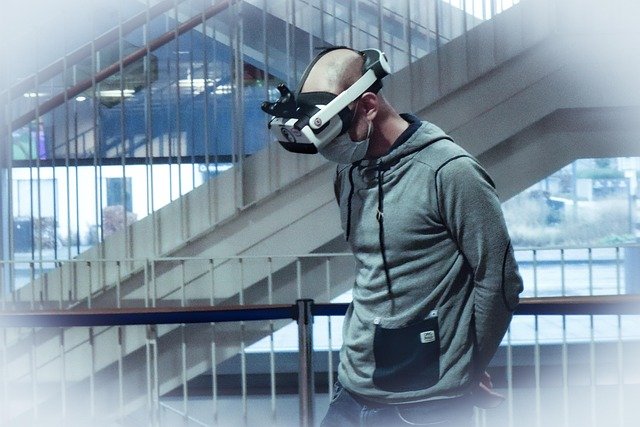
AR (Augmented Reality) and VR (Virtual Reality) have quickly transitioned from a test phase into real working tools and have influenced many industries. With the growth of computer processing, graphics and wearable devices over the last ten years, immersive technologies have become much more available and practical. Currently, AR and VR are used throughout different industries for numerous purposes, including gaming, learning, medicine, building and so on.
AR and VR offer users an interactive experience that is not available using only a screen or some form of display. AR provides an enhancement to the real world by placing digital data on top of the physical world, while VR gives users the ability to enter into a world that is entirely simulated. Both technologies are part of the overall technological movement toward immersive computing, which continues to make digital experiences more realistic and interactive for users.
Regardless of whether it’s for entertainment or training purposes, AR and VR applications continue to grow in number. AR and VR have gained acceptance in the two biggest industries using these technologies, gaming and medical education, because they create a much more engaging and effective experience for users.
Understanding AR and VR
Before looking at the applications of AR and VR, you need to know the difference between AR and VR as well as what makes each technology different.
Augmented Reality: What is it?
Augmented reality (AR) adds digital components (i.e., images, text, animation, and 3D models) to a user’s real-world experience through devices like smartphones, tablets, smart glasses, and/or specialized headgear made for AR. AR enhances (adds to or enhances) user’s perception of their physical environment with digital information. Thus, AR allows users to interact with both real-world objects and digital overlay simultaneously.
AR is used for many practical applications in various fields. Retailers allow shoppers to visually place furniture in their homes before purchasing. Digital navigation apps overlay directions onto actual streets. The field of education has utilized AR by showing 3D interactive models allowing students to visualize concepts that are difficult to grasp.
Virtual Reality: What is it?
Virtual reality (VR) allows the user to be in an entirely different reality (a complete VR environment) than what they currently experience due to the replacement of their real-world perceptions by a simulated environment (digital) created from computers through the use of headsets and motion-tracking systems. In a VR environment, every visual aspect of what the user sees (and hears) are all digitally produced and created – thus allowing the developer(s) to create “realistic” (life-like) representations or entirely fictitious experiences.
VR functions particularly well in various areas including simulation and /or experimental training and of providing immersive storytelling experiences.
The most common way to engage with VR Technology is through the use of handheld controllers, gloves, or motion sensors that detect a user’s body movements. All these types of technology create a sense of presence for the user in the virtual world.
AR/VR Impact on the Gaming Sector
Since its inception, the gaming industry has been one of the main users of immersive technology. As such, the introduction of AR/VR technologies has given players completely different ways to enjoy and experience digital entertainment.
Immersive Gameplay & Virtual Worlds
With Virtual Reality, players can now enter into the game environment rather than just control a character on the gaming screen. Players can now look around the virtual world, inter-act with objects, and move around within the game world physically.
This level of immersion creates a far greater level of realism within a game, which increases the overall enjoyment of the gaming experience because players feel that they are part of the story instead of just a spectator.
In addition to this greater level of immersion, VR technologies also provide advanced motion-tracking capabilities, allowing for natural movements such as pointing, throwing or exploring environments as well as providing players with a more seamless experience through better intuitive movement when playing VR games.
AR and Location Based Gaming
The integration of AR into gaming has opened up an entirely novel way of merging the realities of the physical world (real world) with that of the virtual one (digital world). An example of this can be found in AR games that encourage people to get out of their homes and explore the physical environments around them while simultaneously interacting with these same environments via digital content.
The use of AR in location-based gaming also allows individuals to discover new characters, solve puzzles, and earn rewards in the locations where they actually exist in their communities. As a result, through AR, cities, parks, and neighborhoods alike are becoming interactive gaming arenas.
The rapid growth in AR gaming is indicative of the use of immersive technologies to drive people to become more physically active and engage socially with others while still receiving a compelling form of digital entertainment.
The Potential of Immersive Gaming in the Future
The enhancement of the hardware used to deliver AR and VR gaming experiences will result in even more realistic gameplay in the future. Improvements to haptics (feedback when you touch something), eye-tracking technologies and spatial audio (sounds emanating from a source that is mapped to where the actual physical source is located in a three-dimensional environment) will make virtual environments feel as though they actually do exist in the real world. These developments could potentially lead to entirely new ways of storytelling through interactive games and new forms of social gaming.
AR and VR Used in Education-Learning
Education is another area where AR and VR technologies are having a considerable effect. By providing students with immersive learning environments, AR and VR give the student the opportunity to gain first-hand experiences—something which traditional educational methods typically cannot provide.
Interaction Learning with Visualizations as a Tool to Enhance Student Learning
Many academic subjects have very challenging, abstract ideas that are hard to comprehend without a visual representation for example, the subject of physics has many scientific principles that can only be viewed in a virtual format. If you are studying history, you may be able to view digital recreations of lost civilizations in virtual format that can help you learn about them more effectively.
Not only do AR applications help students learn better by creating an interactive, animated, and visual representation of their textbooks, but they are also helping students learn.
Virtual Classrooms and Remote Learning
VR has allowed for the development of immersive virtual classrooms where students and teachers can use avatars to meet and assist each other with shared learning experiences.
VR makes collaboration among students much stronger than any other video conferencing application (such as Zoom).
As a result, VR is going to provide improved education opportunities to those who otherwise wouldn’t have had access to such a good experience.
The Future of Medicine and Training with AR/VR
Medical education may be one of the most significant benefits of using AR/VR technologies, because future healthcare providers train through real-world experience and AR/VR provide very powerful support for these experiences.
Surgical VR Training
Through VR, medical students can practice surgical operations in a risk-free controlled environment (simulation), replicating the operating room, instruments, and anatomy of an actual patient.
The medical student can practice an operation many times and get instant feedback on their performance without any risk to real patients. VR training will also allow students the opportunity to practice on unusual cases that the students may not get to practice on during this type of training.
The student’s confidence in performing surgery and technical skills will increase with their use of VR before entering an actual operating room.
Clinical AR Support
AR is becoming increasingly popular for helping physicians during procedures. With AR, the physician can see the patient’s information, medical imaging, and navigational guides right in their field of view.
By overlapping this information within the operating room, AR can help the physician make more precise decisions during difficult surgeries, increase accuracy in the surgical procedure, and decrease the incidence of complications during surgeries.
Improving Anatomy Education
It can be very difficult for new medical students to visualize the intricate details of human anatomy. AR (Augmented Reality) and VR (Virtual Reality) can provide students with 3D representations of the organs, muscles, and systems of the human body that they can interact with in a much more immersive manner than normal textbooks or diagrams.
Users of these digital representations will be able to rotate structures, zoom in on tissue, and watch biological processes that will increase their understanding and retention of the material more than would be done through traditional textbooks or diagrams.
Challenges to the Use of Augmented and Virtual Reality
Although AR and VR have benefits, they also have several issues that limit their ability to be adopted on a large scale.
High Cost and Hardware Requirements
VR and AR requires hardware and equipment that can be very expensive for the end-user. For most medical schools and hospitals, the high costs of the equipment is cost prohibitive (especially in developing countries).
Technical Concerns and User Experience
Users of VR/AR for long periods of time can experience symptoms of motion sickness and/or eye strain. Other hardware limitations (battery life, screen resolution) may also have an impact on user experience.
Content Development and Expertise
Developing high-quality AR/VR content requires experience developing 3D design, programming, and user-experience development. Developing realistic simulations and interactive environments can take a lot of time and money.
Upcoming Potential of Augmented Reality and Virtual Reality
Technological advancement is driving advances in AR/VR into a stronger, cheaper and more mainstream product category as advances in AI, 5G and wearable computing will enable immersive experiences to be enhanced.
Gaming will see the introduction of almost photorealistic games in VR with full-body motion tracking, education will enable immersive learning tools to become universal applications used in classrooms throughout the globe.
AR/VR will not only change how medical professionals are trained but also transform patient treatment, rehabilitation, and surgical assistance from remote locations.
End Note:
The impact of AR and VR is redefining the way people engage with digital content. There are countless opportunities opened up through the use of these technologies from its use in generating immersive environments to its application for medical training and simulation.
Although the industry continues to face challenges related to cost, hardware and content creation, continuous innovation is driving immersive technologies beyond their current limits. The continued accessibility of AR and VR technologies provides the potential for them to play critical roles in the future of education, entertainment, and medical care.