
introduction
The concept of the metaverse – an interactive 3D environment that enables users to create and share content via digital avatars, which allows them to engage with one another through the metaverse – has changed dramatically over time since its debut a few years ago. The metaverse was once touted as the next big thing for the internet, though it has been met with considerable excitement as well as a growing amount of skepticism.
Numerous significant traditional and emerging tech firms are continuing to invest in the creation of virtual worlds, immersive technology, and other technologies that may assist in the future development of the metaverse, including blockchain, extended reality (XR), and artificial intelligence (AI). Today, the metaverse is moving into a new phase, as a result of advances in technologies that enable more effective connections between the real and virtual physical worlds.
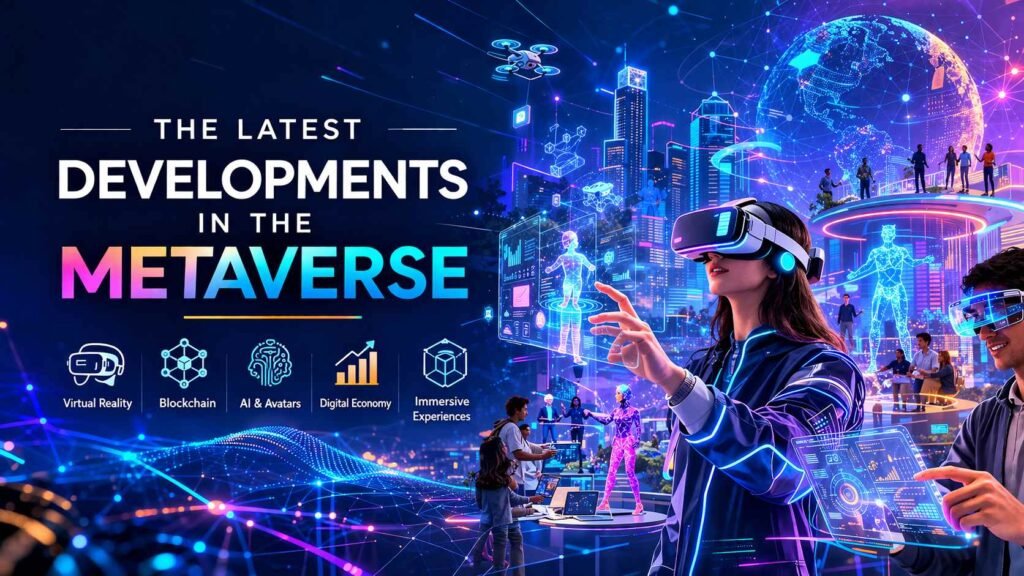
This article will discuss various recent developments in the metaverse, the impact of major technology companies on the future development of the metaverse, new and emerging technologies that are moving the metaverse into a unique digital ecosystem, and the continued growth of the economy surrounding the metaverse.
The Development of Major Tech Companies’ Changing Strategies
Meta’s New Direction
A new strategic approach by technology giants is one of the most noteworthy things to occur in the development of the metaverse recently. Since its rebranding in 2021 from Facebook to become more involved with the metaverse, Meta has begun to pull back from some of its initiatives related to the metaverse. The company announced last year (2022) the closure of its Horizon Workrooms VR collaborative software. In addition, Meta has reduced its investment in its Reality Labs division.
Meta has invested over 70 billion dollars in developing its version of the metaverse since 2020. However, Meta’s decisions are raising questions about how long the large-scale version of the metaverse will continue to be viable as a long-term, profitable investment strategy. Although the company will no longer focus as much on developing immersive technologies, they will invest in developing artificial intelligence and smart glasses.
Meta’s approach is being mirrored across the entire technology industry. Companies are no longer creating standalone virtual worlds but are instead incorporating aspects of the ‘metaverse’ into their overall technological ecosystems.
Gaming Companies’ Ongoing Influence on Platforms
Game development companies are also continuing to change the shape of the development of the metaverse. Gaming platforms that deliver virtual game worlds will remain the basis for a majority of metaverse experiences. The revenue generated from these gaming platforms is the primary driver of the growth of the metaverse economy.
AI-powered gaming tools now exist that allow developers to create entire game worlds using only natural language input. By lowering the barrier for entry on the creation side, these tools will enable more creators to create and upload user-generated content in virtual worlds.
This format could expand the creator economy in the Metaverse and allow millions of people to create interactive experiences without needing programming skills.
Several of the technological advances that are driving the Metaverse include:
Artificial Intelligence & Generative Content
Artificial intelligence is one of the most disruptive technologies in the Metaverse. Generative AI is now capable of creating dynamic environments, intelligent NPC’s, and personal virtual experiences.
AI-enabled environments adapt to user behaviours, can create storylines and will continue to generate unique digital assets in real time. These features will enhance immersion and allow the evolution of virtual spaces as opposed to having static spaces.
Additionally, with AI, Avatars and Virtual Assistants are becoming increasingly realistic, allowing for a much more natural interaction between users and Digital Characters.
Extended Reality Equipment
The metaverse is supported by extended reality technologies (a.k.a. VR and AR) with advancements in hardware design, computer processing abilities and internet speed. Improvements in these three factors are allowing a larger number of users to experience enhanced virtual environments anywhere in the world.
The latest industry data shows that the number of shipped XR devices increased dramatically from around 30 million in 2022 to over 100 million by 2024. The new XR devices are consistently lighter, more robust, and more comfortable than previous models and have overcome early barriers of resistance that stood in the way of widespread XR device acceptance.
Recent innovations in sensing devices, haptics and motion tracking have all contributed to a more realistic physical environment in which users can operate and interact with their avatar(s). Many of the new XR systems will also leverage predictive AII to anticipate user motion, eliminating much of the potential for motion sickness and enhancing the sense of immersion for the user.
Digital Ownership & Blockchain
Another important step toward a fully realized metaverse is the integration of blockchain technology. Blockchain offers a decentralized way for users to manage their digital assets, digital identities, and digital transactions within a virtual environment.
In a blockchain-supported environment, users can own characters, objects or spaces (like digital land) and many of these assets can be easily traded across platforms. This will allow for the establishment of virtual economies and the development of decentralized marketplace solutions.
Governance that is decentralized, through blockchain technology, allows communities to vote digitally on decisions made by groups utilizing a Decentralized Autonomous Organization (DAO).
The Boosting Virtual Economy of the Metaverse
Rise of Virtual Economies
While the concept of a metaverse has met with doubters, the estimated economic size of the different virtual economies is enormous. For example, analysts are predicting that in the next decade the large metaverse market will expand rapidly due to the gaming and the sale of items within the virtual world (virtual commerce) and the sale of services within the metaverse.
Currently video game activity continues to dominate the economic activity in the metaverse; for instance, by 2024, analysts predict that metaverse gaming alone generates approximately $20 billion. However, by 2030 that number could reach $168 billion.
Another area of rapid growth in the metaverse is the area of virtual commerce. Consumers are beginning to purchase virtual items (for example, avatar clothing and accessories and virtual land) in an immersive experience.
Global brands, as well as other companies, are actively pursuing how to leverage the metaverse as a new marketing and engagement channel. Solutions include creating virtual showrooms, interactive advertising experiences, and virtual events that create opportunities for consumers to experience products in an alternative manner.
For instance, many brands are working with digital fashion companies to create fashion that consumers can wear in the metaverse. Some brands are also launching products that are exclusively sold in the virtual world, creating new business models for the metaverse economy.
Enterprise and Industrials
The Industrial Metaverse.
Despite consumer entertainment content receiving most of the publicity, industrial enterprises are starting to leverage the metaverse.
The industrial metaverse incorporates immersive technology across industries, including engineering, production, logistics, and energy. An example is using digital twins of trade materials to enable engineers to create a process simulation model, monitor, and optimize production in real-time.
Using real-time data (for instance, from sensors and connected devices), these uses of immersive visualization allow businesses to test designs, anticipate equipment maintenance, and increase efficiency without having to physically change anything in their operations.
Training and Education
Another key enterprise application of the metaverse is for immersive training simulations across industries such as healthcare, aviation, and manufacturing, where VR simulations are used to train employees as they would in a real-life environment.
Medical student examples illustrate how placing a medical student in a VR virtual operating room for the student to practice surgical procedures gives the student a more realistic experience than using a textbook or video. Similarly, engineers from an aviation manufacturer can rehearse and ‘trouble shoot’ the fix through a VR simulation before they work physically on the equipment.
Many educational institutions are developing and testing how to implement the metaverse into their course offerings, creating virtual classrooms with avatar versions of themselves as instructors and classmates, creating a more realistic visual learning experience than their traditional online education offerings.
Challenges and Concerns
Privacy & Security Risks
The Metaverse presents a number of privacy/security issues, but so far its potential has not been fully realized. Large amounts of data are collected using immersive platforms; therefore, the amount of information being collected on individuals will continue to increase. Many researchers believe this increase in data collected will lead to an increase in cyberattacks, as well as new types of identity theft, and the likelihood of being surveilled by someone.
It will be important to establish an effective means of managing identity securely in order to build trust in metaverse platforms moving forward. There will also need to be established means to govern individual users’ data to ensure security.
Interoperability & Standardization
Interoperability is currently a large challenge due to many virtual worlds functioning as closed ecosystems. This means that users cannot easily transfer assets (including avatars, items) or identity from one platform to another.
Developers are creating open standards that will allow for the seamless transfer of assets/avatars/identity between different metaverse platforms. Examples may include technologies such as Open XR, and the use of universal 3D asset formats.
Without established standards in place, it is likely the metaverse will become a fragmented experience instead of experiencing a collective unified digital universe.
The future of the metaverse
The future of the metaverse will likely involve a convergence of several different types of technology rather than a single, cohesive platform. The “next-generation” digital experiences that will evolve will require components from all of these technologies (AI, immersive hardware, blockchain systems, and high-speed connectivity).
Instead of entirely replacing the conventional internet, it appears that rather than one all-encompassing virtual world, many separate “experiences” could be created using VR/AR technologies.
Several important aspects will determine whether or not the metaverse will develop into an actual digital resource or not beyond 2023 are:
The creation of improved and more affordable AR/VR experiences through software and hardware development
Standardised open-sourced and interoperable platforms that allow developers to effectively interact with each other
The development of AI-assisted content creation
Privacy and security that continuously protect the user’s rights
If all these areas are addressed, the metaverse can potentially be a game-changing resource for digital interactions, interaction-based learning and working from home (WFH) whilst going to school/college/university, and working/business/e-commerce.
Summary of Findings
The transformation of the metaverse is ongoing. The impact of its rapid growth has slowed down compared to its rapid early growth rate, but continuous technological improvements and sustained investments will provide substantial progress in moving forward with implementation.
Some recent examples of developments indicating that the metaverse will continue to evolve rather than disappear are the continued growth of VR and AR-enabled businesses, the introduction of AI-supported content development, VR-based global economy development, and the rise in business applications using VR/AR technologies.
Going forward, rather than an all-encompassing shared virtual experience across all users, the more relevant term could be that the metaverse will evolve as an intricate ecosystem of various interconnected technologies working in combination.
Overtime, rather than focusing on hype and excitement around exciting and futuristic testing versions of all types of proposed products and services, more real-world practical applications will become available to support the user and deliver value to both parties.