
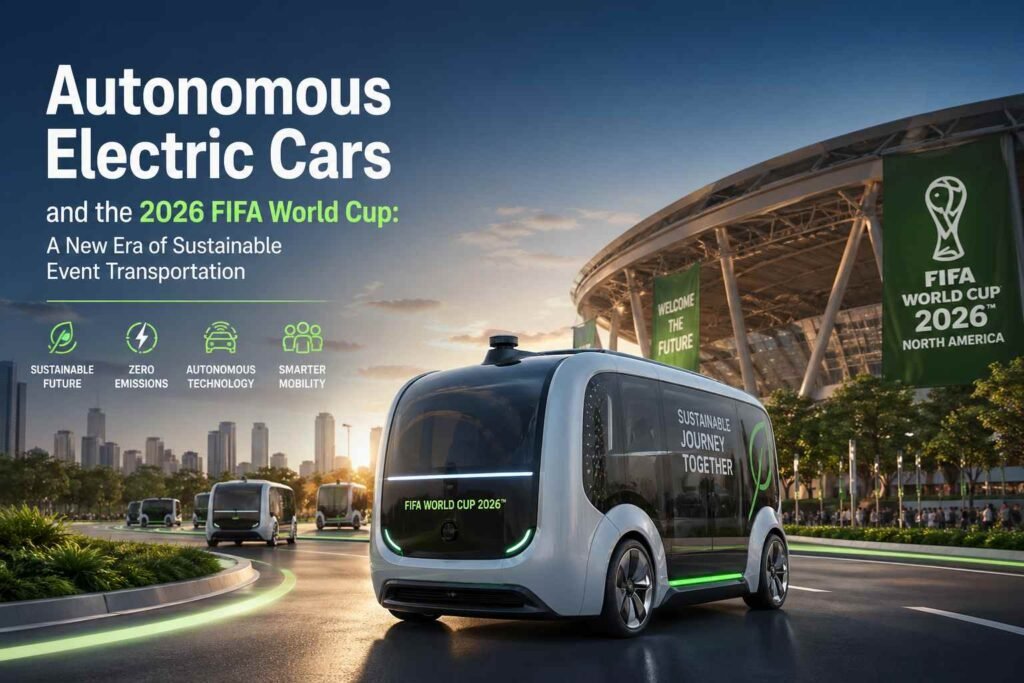
Upcoming FIFA World Cup Introduction
In 2026, there will be the largest soccer tournament ever known globally, known as the FIFA World Cup. The United States, Mexico, and Canada have agreed to be the 2026 hosts of this world event. With the participation of 48 teams, millions of fans will be travelling to support their team by attending hundreds of soccer matches that will occur over a massive area that includes all three countries… transportation for this event will be one of the largest logistical challenges that will face a global sporting event in history.
Additionally, the automotive industry and the technology industry are both undergoing a massive transformation at the same time. Switching from prototype to real-world solutions, self-driving electric vehicles (also called as autonomous electric vehicles) are at the transition point of becoming operational. Many cities will operate with autonomous shuttles, robot taxis, and artificial intelligence-controlled traffic systems in all three of the 2026 host cities.
The intersection of global sporting events and advancements of technology for smart transportation creates a pivotal question for this world event: what role will self-driving electric vehicles play at the FIFA World Cup in 2026?
This article provides an overview of the realistic, practical, and strategic developmental potential for autonomous self-driving electric vehicles to significantly improve the experience for attendees at the tournament and drastically improve the logistics of transportation by providing a much more efficient, cost-effective, and environmentally friendly means of transportation, as well as improving the experience of all fans when attending the World Cup at stadiums and other venues, and contributing significantly to the development of smart cities.
The Transportation Challenge for the 2026 FIFA World Cup
Size and Complexity
Compared to previous World Cups, the World Cup 2026 will be vastly increased in size. Due to the many different venues located across an incredibly wide area (three countries), there will likely be very complex travel patterns for millions of fans, teams, and officials. Major airports will see millions of spectators travelling to supporting their team throughout the tournament, and there will be a very short time between arriving at the airport and arriving at the stadiums and fan zones.
With most of the fans travelling to the sites of the World Cup, they will encounter:
- Significant congestion.
- Overcrowding on public transportation systems,
- Limited places to park, and
- Higher transportation expenses (particularly surge pricing).
Traditional methods of transportation such as buses, taxis, and commuter trains cannot successfully meet the high volume of peak demand created by world sporting events such as the World Cup, thus the introduction of self-driving electric vehicles will change the manner in which fans will travel to the FIFA World Cup substantially.
The Emergence of Self-Driving Electric Vehicles By 2026
Technology Readiness
Self-driving vehicles have already reached a point of maturity at which limited commercial deployment is already occurring. Many Level 4 driverless vehicles are currently being deployed and operated in a limited manner (these vehicles have the ability to drive without any human input in limited defined areas or under specific driving conditions).
There has been a rapidly growing number of autonomous taxi services, and they also collectively have provided millions of miles of autonomous driving from their operational service areas around the world.
Electricity Integration
The majority of autonomous fleets have developed their fleets from electric vehicle fleets and thereby represent two significant technological advancements.
- Autonomous systems (AI-based driving) and Electrification (zero-emission vehicles).
The two green transitions of self-driving electric vehicles are, therefore, very attractive to host nations seeking to promote sustainability while hosting large sporting events.
Three Key Functions Pertaining to Self-Driving Electric Vehicles at 2026 FIFA World Cup.
(1) Solving the Last-Mile Problem.
What is the Last-Mile Problem?
The last mile refers to the distance travelled by many fans to get to the stadium entrance after leaving a relevant major transportation hub (e.g., bus or train station after/or before arriving at the stadium). Although large numbers of fans use buses and/or trains to arrive at a stadium, many of those fans will need to walk significant or ride public transportation long distances from the transportation hub before entering the stadium.
Autonomous Solutions for Fans’ Shuttle Transportation
Autonomous electric shuttles will directly solve these problems because:
- There will be a fixed route between the transportation hub and the stadium.
- The autonomous shuttles will run continually without a driver becoming fatigued.
- The autonomous shuttles can operate very efficiently given their highly-controlled operating conditions.
Estimates are that autonomous shuttles will move thousands of fans per hour and greatly eliminate congestion around the event venues during the events.
The way that the use of autonomous shuttles will change how fans experience attending the FIFA World Cup 2026 event will allow fans to connect with directly to their gate at the stadium to eliminate lengthy travel times from the transportation hub to their designated seating areas thereby increasing the transportation convenience for fans and enhancing the enjoyment of fans when attending the FIFA World Cup.
2.Enhancing Urban Mobility and Reducing Traffic Congestion
Smart Traffic Flow – AI (Artificial Intelligence) used in self-driving cars allows them to adjust their routes in real time. As a result, this will allow cars to:
- keep a steady speed.
- reduce the amount of stop-and-go traffic on the roads today.
- be coordinated through smart traffic systems.
Coordinated Fleet Management – Autonomous fleets can be coordinated to provide on-demand transport by preparing cars to be in areas of high demand (ie, at or near event venues) prior to the conclusion of an event and redeployed following the event. This coordinated approach decreases congestion and creates a more distributed traffic pattern in metropolitan areas.
Benefits on the Event Level Include:
- shorter travel times
- reduced gridlock for stadium traffic
- more predictable travel times
While autonomous vehicles do not completely eliminate congestion, they will significantly reduce the severity of congestion-related traffic accidents.
3.Eliminating Driver Shortages and Saving Money
– The Problems with Traditional Ride-Hailing Services
The issues with traditional ride-hailing services are that:
- There are not enough drivers,
- Drivers generally wait a long time for rides,
- The use of surge pricing.
The Benefits of Self-Driving Cars – Self-driving cars do not rely on a human to drive, therefore:
- They can be continuously in use (no shifts or breaks); therefore, they are a consistent source of availability.
- Surge pricing will be reduced.
As a result, everyone will be able to attend sports events using autonomous vehicles at a more affordable cost than previously possible.
4.Supporting A Sustainable Goal – Green World Cup: 2026 World Cup
The 2026 World Cup is committed to reducing its negative environmental impact, primarily from transportation.
Electric Self-Driving Cars will help in that mission because:
- They have no tailpipe emissions,
- They have reduced fuel consumption,
- They will assist in creating cleaner air in urban communities.
Additionally, there will be a wider range of environmental benefits due to the reduction in carbon footprints for fans, as well as less noise in host cities and additional support for United Nations global climate change goals. This will allow the 2026 World Cup tournament to be a platform for sustainability solutions for mobility to sporting events.
5.Improving Accessibility and Inclusion
– Experiences of Persons with Disabilities in Attending Large Sports Events – Many people who have mobility or visual impairments have a challenging time accessing sports events due to all of the barriers.
Solutions to Accommodate Individuals with Disabilities Using Autonomous Vehicles:
- Providing precise pick-up and drop-off locations.
- Providing wheelchair-accessible vehicles.
- Providing AI communication systems to assist with providing instructions for riders.
These above-mentioned features will help allow individuals with disabilities to be less reliant on human assistance and provide them with a greater level of independence.
- Improving The Fan Experience
– Convenience and Comfort. Electric self-driving vehicles provide a more relaxed ride than the average car and provide a quiet ride.
Fans will have the opportunity to:
- relax before their game,
- be free from the worry of parking, and
- not have to navigate an unfamiliar city during their journey.
Digital Interface
– The future of mobility may include:
- A fully integrated digital platform for ticket purchasing and accessibility,
- Booking transportation from the airport through a single app to outside of the stadium.
Unique Experience – For many fans, riding in an autonomous vehicle will be a unique part of their World Cup experience; therefore, it provides a futuristic experience.
- Supporting Logistics and Operations
– Support for Non-Fan Transportation Needs of the Tournament Using Self
-Driving Electric Vehicles:
- Staff transport,
- Media transport,
- Provide for patrol/security during the event, and
- Move equipment to and from the stadium.
Efficiency – Autonomous fleets will operate 24 hours via a central fleet management system which will allow teams to communicate with one another regarding logistics while reducing overall operational costs.
Limitations and Challenges:
1.Limited Availability
Limited supply of infrastructure in host cities to deploy autonomous vehicles at an acceptable level; therefore, autonomous vehicle usage will be limited to:
- Slow-speed zones,
- Pilot an autonomous vehicle and
- Certain cities.
2.Legal Barriers:
Every country has different laws surrounding the operation of autonomous vehicles; therefore, every country will require individual regulatory approval which may limit large-scale deployment of autonomous vehicles.
3.Self-Driving
Self-Driving Technologies’ Public Acceptance
Some people are uncertain about self-driving car technologies.
They have concerns about three main items:
- The safety of these systems
- Their reliability
- The loss of human control
4.Autonomous Systems Infrastructure Needs
In order for autonomous systems to function correctly, the following types of infrastructure will be needed:
- “Smart” roads
- Accurate mapping
- Communications networks
Not all of the cities that will host the World Cup are equally capable of providing this infrastructure.
The Long-Term Implications of World Cup Transportation
A Global Exhibit
The 2026 World Cup will serve as a model for how autonomous vehicles can work together on a large scale. The event will highlight the capabilities of autonomous systems under conditions of extreme demand.
Data & Innovation
The use of autonomous vehicles to collect data at the World Cup will provide new insights into improvements in:
- Traffic management systems
- Vehicle performance
- Passenger interaction systems
- A Legacy for Host Cities
Investment in infrastructure improvements including smart traffic systems and EV charging stations will create a long-term benefit for host cities after the tournament is completed.
The Future of Transportation at Mega-Events
A Hybrid Transportation Model
There will probably be a combination of:
- Traditional public transportation (buses and trains)
- Traditional vehicles
- Autonomous fleets of electric vehicles
Self-driving vehicles will supplement existing transportation methods; they will not necessarily replace existing methods.
Building Smart Cities
As AI, electric mobility and digital technology become integrated, cities will move toward to becoming smart cities.
Summary
While self-driving electric vehicles will not completely redefine how people transport themselves around the 2026 World Cup, they will be an extraordinary supporting mechanism. The most significant impact of self-driving electric vehicles will occur by:
- Solving challenges associated with last-mile transportation
- Reducing congestion, and improving the flow of traffic
- Enhancing the total sustainability credentials of transportation through emissions-free travel
- Providing equitable access and inclusivity in mobility
- Providing a seamless and futuristic fan experience
At the same time, limitations in necessary infrastructure, regulation and public acceptance will keep deployment narrow as opposed to universal. Thus, the 2026 FIFA World Cup will be a momentous occasion that illustrates where the future of transportation is headed and shows that the transition of self-driving electric vehicles from an emerging technology to a regular-based technology is beginning.