
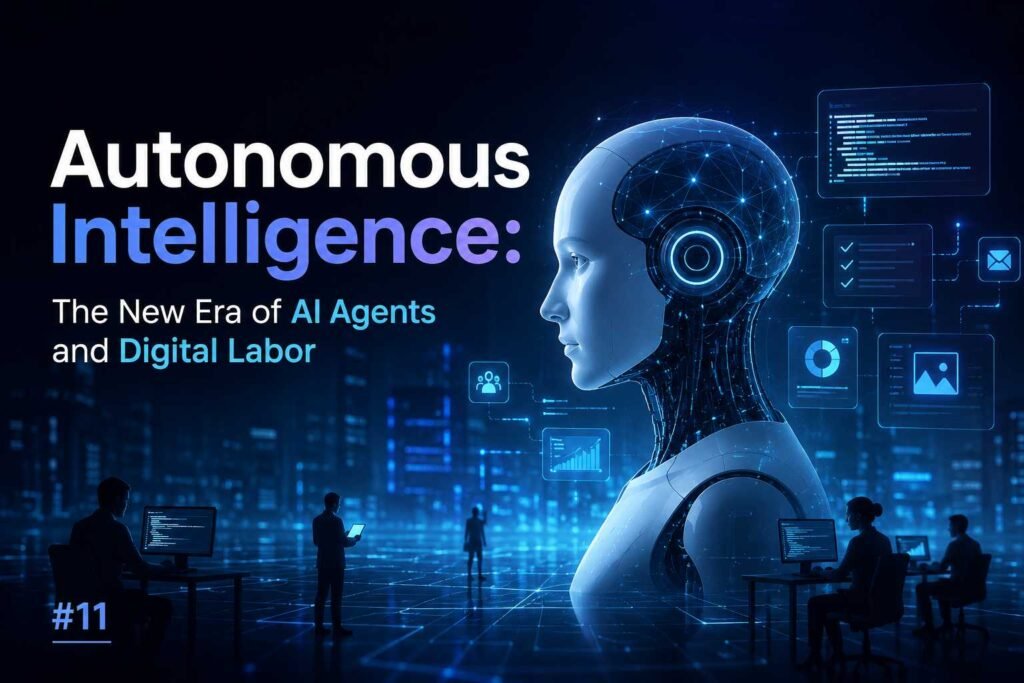
For many years, artificial intelligence (AI) was only described as a powerful tool to augment the ability to use data, automate repetitive activities, and help with decision making. However, the definition of AI has changed recently and therefore it can no longer retain that same definition of merely being a tool. We have now entered into the Age of AI Agents, where AI no longer serves as merely a passive tool to assist people and organisations; rather, AI has evolved into an entity that is more dynamic and capable of reasoning, planning and executing tasks. AI has become collaborative with both humans and other systems it interacts with.
This evolution in AI can be characterised as one of the largest technology transformations since the introduction of the internet. AI agents are not simply an advanced version of tools, but rather digital workers who can carry out complex objectives with many sequential steps and minimal human input. As individuals and organizations shift to accommodate this evolution, there will be far-reaching impacts on productivity, employment, innovation and ethics.
In this article, we discuss the evolution of how we perceive AI agents, the characteristics of an AI agent, the industries that are being changed because of AI agents and the potential consequences of AI agents in a society where machines no longer perform just as assistants to human beings, but are now working alongside humans as equals.
From Passive Tools To Active Agents
AI’s Historical Functionality
In the past, AI systems were operated merely as response-based tools. AI systems would wait for a user to perform an action and then produce a reaction based on either programmed rules or data from a history of prior training. For example, a recommendation engine will give product suggestions and a chatbot will respond to customer queries, but the AI has a small point of interaction.
Although these systems were very helpful for the user, none were capable of functioning in an autonomous manner. None of these systems could take action on their own (i.e., set a goal or move outside of their training.
Changing the Historical Perspective of AI
The development of new agents demonstrates the evolution of AI systems from reactive to proactive (i.e., agents). Unlike a traditional AI system, an AI agent is designed to:
Understand a goal (as opposed to just being provided with an instruction);
Create a series of planned actions/instructions;
Perform an action on multiple platforms;
Continuously adapt and learn from experience/real-time execution;
Interact with other systems independently of the user;
All of the above reasons are contributing factors to the rate of acceleration in agent-based architecture of AI agents. There has been a large amount of development around new technologies such as LLM and reinforcement learning, LMAI and multimodal AI systems. Companies like OpenAI have developed new models able to think logically, create written communications, write computer programs, and recreate human decision-making processes. Using these technologies has the ability to lay a foundation for agent-based architecture.
The Key Characteristics of AI Agents
Essence of AI Agents
A basic AI Agent is much more than an intelligent computer program or an enhanced algorithmic system. An AI agent is an entity that can act independently toward an ascribed goal due to its possession of a defined agency characteristic.
1. Autonomy: An AI Agent’s Ability to Work Independently
AI agents can perform tasks independently from humans. They can also figure out how to achieve their goals, once they have been set by a human.
2. Goal-Oriented Behaviors
An AI agent may have many different targets to achieve, rather than one specific command; for example, an AI agent may manage an entire project, find areas to optimize a workflow or execute a marketing plan.
3. Memory and Context Awareness
AI agents will always remember events over their entire history and thus can base their decisions on previous interactions as well as changes in an environment.
4. Tool Integration
AI agents can use or connect with any external resource including an external database, API, or software application. Therefore, they can provide a bridge between disparate digital environments.
5. Adaptability
Through the agent learning mechanisms, AI agents can develop new strategies of execution and improve their overall performance with time.
AI Agent Architecture
LLMs as the Foundation (Brain):
A large language model (LLM) is at the core of the majority of the agents used today. An LLM allows an AI Agent to reason and communicate. An LLM allows an AI Agent to read instructions to carry out a command; formulate a response to a command; make decisions on behalf of an owner/user.
Orchestration Frameworks: Laying Out the Blueprints
In addition to the LLM, AI agents depend on orchestrating frameworks, such as:
Task decomposition
Workflow execution
Error handling
Feedback loops
Orchestration frameworks transfer raw intelligent LLMs into a structured form resulting in translatable action from an agent.
Systems of Memory
Both long-term and short-term memory are used by agents that provide continuous monitoring and service delivery.
Some ways in which this is accomplished is through:
- Keeping tabs on the status of work being completed.
- Retrieving information about customer preferences.
- Analyzing historical information to improve decision-making.
- Improving access to information for customers throughout their journey.
Examples of how AI agents are changing the way we do business include:
1. Automate workflow.
By automating workflows with AI agents, organizations can change how they deliver service to clients.
With customer service, agents will allow organizations to complete the entire customer journey with limited human interaction.
Through marketing automation, AI agents will allow organizations to develop, distribute, analyze, and optimize their marketing campaigns in real time.
Organizations will be able to continuously monitor markets and generate reports on the performance of their products through AI agents.
Organizations will also be able to execute trades via automated trading strategies through AI agents.
2.Enable collaboration on software development.
AI agents are changing the way that programmers create software from a manual process into a collaborative effort.
Programmers are spending less time writing and debugging code and more time supervising the creation of software by the AI agents.
Programmers are now tasked with managing source code repositories, deploying applications, and monitoring the performance of the applications they create.
Improve efficiency and reduce administrative work in Healthcare.
Through AI agents in healthcare organizations, significant reductions in the amount of time spent on administrative work and improvements in workflow efficiency will occur.
AI agents can assist with the following functions in the Healthcare sector:
- Triage of patients prior to arrival.
- Documentation of medications and prescriptions.
- Drug research and development.
- Creation of personalized treatment plans.
- Improved productivity for End-users.
AI agents will also allow individuals to improve their productivity through the use of digital assistants.
Individuals will be able to:
- Coordinate their weekly schedule.
- Research topics of interest.
- Draft their email and reports.
- Conduct their online transaction.
The way technology engages with us will change from being a direct user to delegating to technology.
Digital Labor’s Economic Impact
A New Workforce
AI agents have opened the idea of Digital Labor, or machines that do jobs we have always done. The impact of Digital Labor (AI agents) on our economy include:
Increased productivity
Less cost to operate the business
Faster innovating of products and services
Businesses will be able to expand without needing to grow their number of employees and therefore be able to improve their profitability.
Job Transformation Not Job Elimination
Although some people believe AI agents will result in the loss of jobs, the reality is much more complicated than that. AI agents will likely:
Take over repetitive execution jobs
Supplement the abilities of people to perform jobs
Create new jobs for people that will involve monitoring and providing strategic direction to the AI agents
The shift of the employee from performing tasks to overseeing the operation of intelligent agents.
Ethical and Governance Issues
Accountability
If an AI agent makes a decision, who is responsible? This is especially important with AI agents making decisions in the following industries: healthcare, finance, law.
Transparency
The decision-making process for most AI agents is unclear. We need to create accountability and transparency in our AI agents.
Bias and Fairness
If AI agents are trained using biased data, they will continue to create inequality. This means we need to continuously monitor AI agents for bias and build in ethics when designing the AI agent.
Security Risk
Autonomous systems need to be properly secured from malicious hacking and if not secured they could result in incorrectly operating AI agents harming individuals, businesses, and ultimately the world.
Collaboration between Humans and AI
Making The Transition From Users To Managers
With their increasing capability, AI now allows humans to have more of a managerial role rather than a user. Previously doing things (tasks) directly to now define objectives through; Setting constraints around how that will be done; Monitoring successful delivery of that task; Managing the task as needed throughout its lifecycle.
Augmented Intelligence
AI is not replacing humans, but rather providing them with enhanced decision-making capabilities through providing insight, simulation and recommendations faster than previously possible.
Technology Stack That Allows for The Era of Agents
Cloud Computing
The scalable infrastructure found through a cloud provider allows agents to perform continually and with a larger workload.
APIs & Integrations
Agents must operate using a combination of multiple systems, either residing in the same location or not, such as email and/or financial systems.
Data Ecosystems
High quality data is critically important in making sound decisions and providing an opportunity to learn.
Barriers To Adoption
Trust
Many organizations are hesitant to grant full autonomy over AI due to the fact there is too much risk and uncertainty typically associated with AI.
Technical Limitation
Due to the speed of AI advancement, there are still factors that will impede their ability to work independently;
The ability to do complex reasoning;
The ability to plan for the long-term;
The ability to manage ambiguity;
The amount of unclear regulations;
Many governments are still working on developing the type of regulations needed to govern autonomous systems.
The Future Of Autonomous Digital Entities
Multi-Agent Systems
The next evolution of AI will occur through the formation of networks of AI agents who will work together to achieve difficult tasks that could not otherwise be completed separately. These networks will have the ability to;
Split up the work into multiple agents of various specialization;
Coordinate their actions and plans;
Collectively optimize their outcomes.
Improving Oneself
In time, the agents will gain the ability to modify their algorithms and, therefore, continually improve and develop without receiving instructions from any humans directly.
Everyday Services
The use of artificial intelligence will continue to expand into all aspects of life from finances to managing a business to help people with day-to-day tasks.
Strategic Considerations for the Business of Agents
Benefits for Early Adoptive Organizations
Organizations that make use of an Agent (AI) early on will receive several benefits such as:
- Improved efficiency
- Faster decision-making
- Improved customer service
- A New Way to Structure Organizations
The hierarchical structure of the traditional organization will change into a hybrid formation, which is where the agent will sit side-by-side with people in the workplace.
Preparation for the Age of AI Agents
Future Competencies
People will have to develop new competences that they can use in the Age of AI Agents, such as:
- Critical Thinking
- Understanding AI
- Strategic Management
- Flexibility
To Prepare Organizations for the Coming Age of AI Agents
- Financial assets
- Training for employees
- Ethical Standards
- Security Agreements
Final Thoughts: A New Work Definition
The Emergence of AI Agents creates a new paradigm regarding how we understand work, productivity, intelligence, etc. AI has progressed beyond merely being an instrument—it is now also considered an entity capable of functioning autonomously and providing value to the labour process as an entity.
While technological advancements have created a drastically different way to define work, they have introduced their own set of challenges including ethical concerns over use, regulatory and legal exclusion, and limitations placed upon technology itself.
The possible benefits to this paradigm shift would include enhanced productivity, creativity, and empowerment of all humans.
As we advance through this period of transition, the question should not be if/how we see AI agents integrated into our lives; rather, what will be our approach towards integrating, managing and working alongside AI agents?
Individuals who embrace this change will not simply be reactive to the future; rather, they will actively participate in shaping it.