
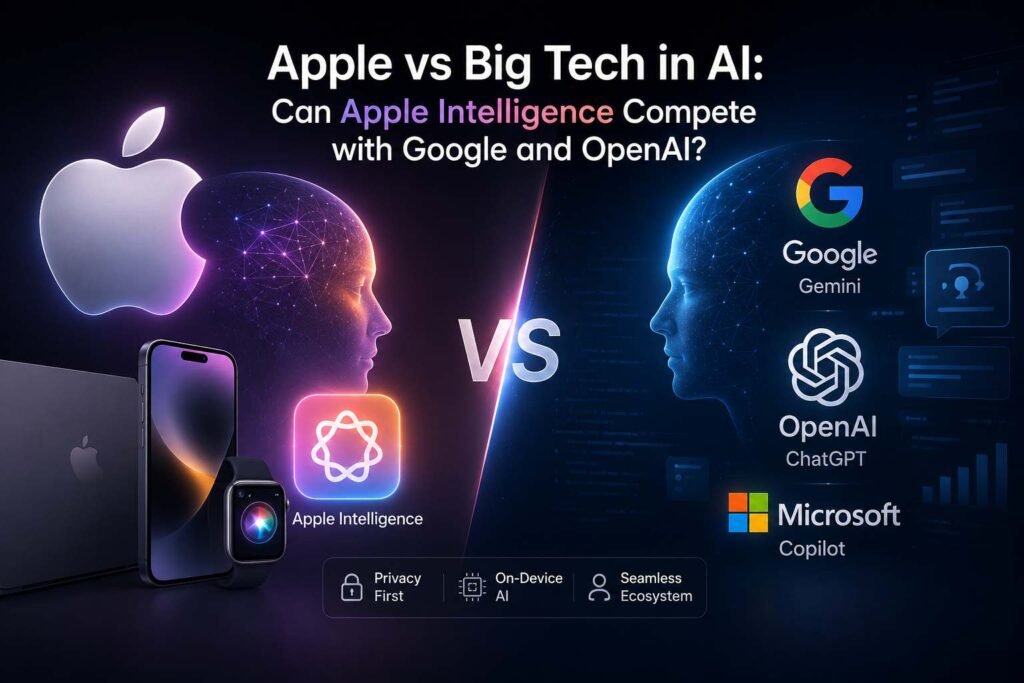
AI has quickly become the most critical battleground in the technology industry and Apple is now under additional scrutiny to demonstrate that it has a viable competitive option among the market leaders (Google, Microsoft and OpenAI). Following several years of conservative positioning, Apple is rapidly advancing its artificial intelligence strategy, which is based upon its ecosystem-first approach to product design, and its position as a privacy leader.
From significant product announcements anticipated at WWDC 2026 to Apple Intelligence capabilities related to each of its product lines, 2026 will clearly be a critical year in this rapidly evolving space. This article will discuss the latest Apple AI developments and what the future of AI may look like at Apple.
The Emergence of Apple Intelligence
What is Apple Intelligence?
Apple has officially launched its generative AI development with Apple Intelligence – a sophisticated solution that delivers powerful new capabilities for every Apple device (iPhone, iPad, Mac). Unlike other cloud-based generative AI platforms currently available on the market, the focus of Apple Intelligence is to encourage high levels of on-device processing for both performance and privacy.
Examples of features currently powered by Apple Intelligence include:
smart workflow solutions for writing
real-time translations of text and speech
AI-enhanced notifications
creation and modification of images
The Apple ecosystem approach allows users to access their artificial intelligence features as an integral component of their daily workflow rather than requiring them to use those features independently.
A Comprehensive Look at Apple’s AI Strategy Focused on Privacy First
Apple has an advantage over other companies because of their dedication to privacy through their AI architecture. By carrying out AI processing using Apple’s silicon chip inside the device, Apple reduces the need to send data to the cloud and limits how much data can be shared.
As a result, Apple’s approach:
Gives less information about the user
Works faster
Adds to the user experience
Although this approach limits scalability and flexibility by not using cloud-based AI systems as Google and Microsoft do.
Apple AI Latest News in 2026
1.iOS 27 and the New Wave of AI Features
With the launch of iOS 27, Apple is likely to showcase many of their latest AI capabilities. The AI based features that we can expect them to promote include:
AI photo editing tools
Siri’s smarter abilities
Adding AI to Safari, Wallet, and Messages
Automation based on context
Apple will also have AI as a focus at WWDC 2026.
2.Third-Party AI Integration (A Major Change)
A major change in how Apple operates, it is reported that Apple may give the user choice as to what third-party AI models they wish to use while in the Apple ecosystem.
For example, Google Gemini and Anthropic AI could become part of the user’s AI toolkit.
By allowing the user to select an AI provider using settings within the operating system, Apple is taking a major step away from their history of having a closed ecosystem.
3.Siri’s AI Transformation
Since its launch, Siri has gone through more changes than ever before and is expected to be able to complete many more tasks.
4.AI-Driven Photo & Camera Services
Apple has announced new AI powered features within PHOTOS; among these will be:
- Image extension and reframing
- Smart enhancement words
- Photo voice command control with Siri
With this latest round of advancements, Apple is moving closer to rivaling other big photo and camera service providers such as Google Photos.
5.Potential AI Revenue for Apple
Analysts predict that AI could be a major contributor to growing Apple’s business.
Apple may generate approximately 15 Billion dollars a year from AI Features through its existing services
Apple devices will make AI accessible to approximately 20% of the population worldwide
Apple’s strength is the Largest Global Distribution of Hardware.
Challenges Apple Faces Deploying AI
Delays and Lawsuits
Apple’s entry into AI hasn’t been without its problems.
Significant media controversy over delays with Siri’s deployment of AI features lead to:
- A 250M settlement
- Customer dissatisfaction
- Publicly questioned whether Apple was ready to compete with AI products vs. competitors
The delays gave competitors an opportunity to gain competitive advantage.
Apple Taking Longer to Compete
Apple has a market perception that it is significantly behind:
- Google
(Gemini) - Microsoft
(Copilot) - OpenAI
(ChatGPT)
While Apple spends their time focusing on integration and privacy around AI, competitors have made significant strides in providing the latest and greatest AI solutions.
Challenges Apple Faces Internal to Company
Apple has publicly acknowledged that internally they are:
- Providing training for their engineers on coding AI tools
- Working to re-structure their resources
- Working to accelerate their cycle times for product development
There is internal transparency that surfaces that Apple must work much faster than anticipated to be successful with AI.
Apple’s Artificial Intelligence Hardware Strategy
Apple’s Artificial Intelligence hardware utilizes proprietary integrated circuits as the basis of its AI system:
The Neural machine learned processing unit
New M series processors
The future version of the M processor series (M5) will provide greater ability, speed, and efficiency for Artificial Intelligence.
In addition to using AI to make our lives easier, the Company will also develop entirely original hardware driven by AI, and will include devices such as:
An intelligent home base
Intelligent home security systems
Intelligent wearable glasses
Apple and the Competition: An Important Comparison for Business Planning.
- The Company’s Technology Strengths:
Deep integration into the Apple ecosystem
Strong focus and leadership on privacy issues.
A significant user base
A strong synergy between hardware and software - The Company’s weaknesses:
- Longer Time to market for new applications.
Limited ability to support AI in the Cloud.
Dependence on purchased device upgrades.
Competitive Differences between Apple and Other Companies
There are two significant differences between the Apple position and that of its main competitors in AI hardware:
- Apple is a Product-first: As a product-first Company, Apple is well positioned to support development of Artificial Intelligence.
- Apple is a Cloud-first competitor: Apple is building a product first in AI. This defining difference along with both the ability of the Apple ecosystem and the Apple Strategy, could play a significant role in determining how quickly consumers adopt artificial intelligence in their homes.
The Role of the WWDC 2026 Event
The WWDC event scheduled for June 2026 may prove to be a turning point in the AI Race.
As expected, the Apple Job Ref Page will be updating on this page. Additional announcements may include:
Either the iOS 28 version
Apple Intelligence features
The development of a new Siri
Developer AI tools.
The outcome of WWDC 2026 will determine if Apple will regain the momentum in the race for Artificial Intelligence.
The Future of AI by Apple will be
Smart Contextual AI Future Apple AI will:
- Help to deeply understand user context/behavior
- Automate day-to-day activities/tasks
- Integrate smoothly and quickly across applications
AI Ecosystem Grow/Expand Apple is expected to:
- Open all API’s for developer utilization
- Allow 3rd party’s ability to create connect to Apple products using AI
- Expand usage of AI to all Apple Services
Monetizing Opportunities AI will monetize sales through:
- Services subscription model
- Below-mentioned monetization through App Store Ecosystem/Revenue Model
- Expedited premium device creation (upgrades)
- AI: Core Platform AI is No Longer a (simple) Function or Feature-it is evolving to be an Official Platform within the Apple Ecosystem.
Final Words:
Apple has reached the turning point in the Corporate Development of AI. The company initially was behind the curve with artificial intelligence development when competed against their competitors but Apple is escalating rapidly through Apple Intelligence, Siri-Upgrades and Software Applications being developed with Artificial Intelligence technology.
The main question is not: Will Apple be successful at Artificial Intelligence. The main question is; how different will Apples’ success be from its Competitors.
Apple has joined the Artificial Intelligence ecosystem and successfully positioned itself with new diverse pathways through the potential of Data Privacy Support, Integrating Platforms, and Hardware Optimization. The major key to Apples’ success is Execution.
No delays, Competition-to achieve at all levels expectations from all users and provide a Transformative transaction, like WWDC 2026; this will allow Customers to utilize all of Artificial Intelligence within Apple.
For further information on Apples’ AI Development and for official information on AI by Apple visit: