
Beginning
Silicon Valley has always been a contention of ideas, money, and dreams of success. From early computers to social media to mobile ecosystems, each period has had its top players fighting to control how technology will develop.
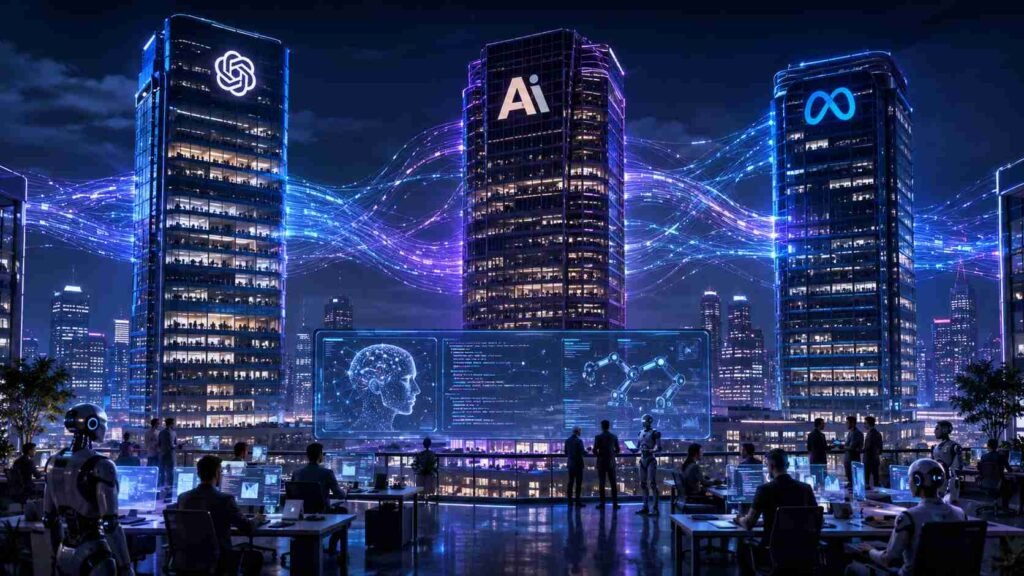
In 2028 we are in a new war that is larger than all the wars we have previously fought, which is for the future of work influenced primarily by Artificial Intelligence.
There are three major players competing for dominance in the future of work via Artificial Intelligence: OpenAI, Anthropic, and Meta.
Each company has their own way of thinking about how AI is or can be applied, their own technological means for developing and using AI, and their own business plans for monetizing AI.
Each company is redefining how humans will interact with machines, how businesses will run, and how content will be created and distributed.
This article will describe how the AI war to dominate the future of work developed, the specific strategic differences between the three players, and how the results of the war will affect the global economy.
The Growth of AI As The Center of Work
Tools To Autonomous Systems
For the past ten years, Artificial Intelligence (AI) has shifted from being narrow-use tools that automate certain tasks to advanced systems which have reasoning capabilities and the ability to generate content and make decisions.
This new technology era is being characterised by a fundamental change in how AI is viewed. No longer simply an assistant, it is beginning to be considered as a partner and collaborator.
AI now does much of what traditional methods do – write code, create marketing strategies, perform research, and mimic human behaviour through conversation. The result is an alternative way of working and understanding productivity for everyone.
The Economic Stakes
With the economic implications of this transformation being so large – trillions of dollars globally over the next decade – the companies leading the way in AI will be the leaders in technology and will also have a say in all types of industries, including healthcare, financial services, education, and manufacturing.
Competition among OpenAI, Anthropic and Meta is therefore not based solely on innovation but rather on control of the future economy’s infrastructure.
Open AI | Pharma as a Driver of Intelligence for Caregivers
A Vision of Universal AI Access
OpenAI is the largest company that has placed a strong focus on making high-end AI accessible to a large community of users. The company’s strategy shows that it values the implementation of AGI for all of mankind through user-friendly, scalable and integrated products.
Ecosystem and Strategy for Product Development
A big part of OpenAI’s success stems from creating and maintaining a cohesive product ecosystem. OpenAI’s models drive customer-facing solutions across multiple sectors (content creation, customer service, software development, etc.). OpenAI also integrates its product offering within enterprise organizations via the application programming interface (API) or enterprise solutions that have woven their way deeply into companies’ workflows globally.
Strengths and Challenges
One of OpenAI’s substantial advantages is being able to scale rapidly; however, this rapid growth brings risks with regard to safety, governance, and competition. OpenAI must maintain an equilibrium between innovation versus responsible development for the ultimate sustainability of business.
Anthropic’s AI Development Philosophy – Starts with Safety First
Alternatives to OpenAI: A Different Lens
Anthropic has approached their AI development methodology differently than OpenAI; Anthropic has been built upon strong principles regarding safe and aligned baseline models. In this type of development methodology, safety and alignment are the primary design principles used to develop AI system(s) which will provide reliable output based on interpretability and/or alignment with human values.
Constitutional AI – Ethical Principles Guiding the Decision-Making Process without Requiring Human Oversight
Anthropic introduced the concept of “Constitutional AI.” This unique methodology uses ethical principles to guide how ‘Constitutional AI’ models make decisions (or apply outputs of these models) based on ethical decision-making rules without the need for constant human involvement.
Market Position
Although Anthropic has not achieved similar levels of penetration into the market as OpenAI, its emphasis on safety has led it to become the preferred partner for companies seeking to manage risk and comply with regulations. As a result, the company has positioned itself as an important player in regulated sectors like finance and healthcare.
Meta: Open source and Ecosystem Dominance
Leveraging Scale and Infrastructure
Meta has an advantage over competitors as it enters into the AI arms race; its enormous user base coupled with its existing infrastructure provides assistance to Meta with developing and training AI systems through the use of vast amounts of data from billions of people using Meta’s various platforms worldwide.
The Open Source Strategy
Meta has taken an open source approach and made its AI models available to the public; in doing so, the company hopes to inspire innovation and generate a global ecosystem of developers focused on advancing AI technology. Therefore, not only does this strategy accelerate the rate of adoption but it also places Meta at the center of AI development.
Integration Across Platforms
AI technologies that Meta is developing and refining are integrated across the company’s existing suite of products – both traditional social media as well as virtual reality. This allows Meta to provide users with unified experiences as well as to develop new usages of AI technology across its platforms including within the nascent metaverse.
Top Conflict Zones in the AI Combat
Talent Acquisition
Talent is one of the most important factors in this battle. Companies are competing for top-quality AI researchers and engineers because demand for these types of workers is incredibly high. As companies compete for these individuals, they will provide attractive salaries, exciting projects to work on, and a pleasant, positive company culture as part of their recruiting strategy.
Infrastructure and Compute Power
AI development requires a significant amount of compute power. Thus, the companies that can invest in developing an advanced infrastructure will have a noticeable competitive edge. Developing infrastructure includes having access to high-performance (GPU) devices, developing (or having access to) data centers, and having energy resources.
Partnerships and Ecosystems
In addition to infrastructure, companies can also gain an edge in the AI battle by developing and leveraging strategic partnerships in developing a solid ecosystem. Strategic partnership ecosystems can help companies developing cloud computing solutions, creating software to automate business processes, or leveraging educational institutions to develop applications for the growing demand for AI-powered students.
Ethical and Regulatory Challenges
The Need for Governance
As AI systems advance, so too does the need for establishing regulation for the responsible governance of these AI systems. AI systems are becoming increasingly advanced, leading to the need for governmental organizations across the globe to begin creating frameworks for governing the responsible use of these systems.
Balancing Innovation and Responsibility
Businesses must also find a balance between pushing the boundaries of innovative technology while at the same time, responding to the concerns of customers about their privacy, potential biases, and the potential of using AI systems for nefarious purposes when developing AI systems. For many businesses, this may pose a challenge as they seek to be on the cutting edge of AI innovation while continuing to build consumers’ trust.
What Impact Will the Future Shape on Employment?
Automation Trends and Changes in Job Roles
Many repetitive clerical processes can expect to be performed automatically by AI. With the introduction of automation, job functions will dramatically change—roles will be lost while new categories of jobs open for example within roles that manage AI, analyze data, and create digital assets.
The Partnership Between Humans and AI.
Worker and AI partnership will be a common working environment in the future as AI solutions will serve to enhance the productivity of human users so they can devote time on higher levels of proficiency in their job roles/tasks.
Education and Skillsets to Maintain Relevancy in Change
Individuals will have to change with their external environments and build new competencies to remain employed. Building new skill sets will include expanding technical capabilities, critical thinking competencies, creativity, and adaptability competencies.
Strategic Path of Future AI Leadership
All three companies are on different paths to reach the goals of AI leadership through the following paths:
OpenAI believes scale and access will provide leadership in AI.
Anthropic believes safety and alignment will provide leadership in AI.
Meta believes that using open-source innovation approaches and market-winning ecosystems will provide leadership in AI.
The Overall Winners Will be a Diverse Community of AI Leaders
Diversity of AI Leadership will produce a community where multiple leaders may coexist, rather than produce a single leader. Each of the units has addressed a unique aspect of the AI landscape and ultimately are complementary and, therefore, do not have a purely competitive relationship.
Conclusion
The war for Silicon Valley is much larger than the battle between individual technology companies. This represents a historic moment in the evolution of technology itself. Companies such as OpenAI, Anthropic and Meta, can influence both the future of AI, but also the future of work.
As this war unfolds the effects of this battle will be seen throughout all sectors of the global economy. Therefore, businesses, governments and individuals must prepare for a new way of living and working where AI is part of our lives vs just a tool.
The key question in this battle is not who will win, but rather how the results of this battle will determine the future of humanity.