Introduction: A New IT Technology Leadership Age
Come 2026, it would become clear that the global technology landscape has entered a major transformation. The hyperscale cloud providers and AI native start-up businesses, who have been driving the majority of development in the past ten years, now have in common with some of their predecessors, who are viewed no longer as competitive, their rebirth and engagement in shaping the artificial intelligence of the future.
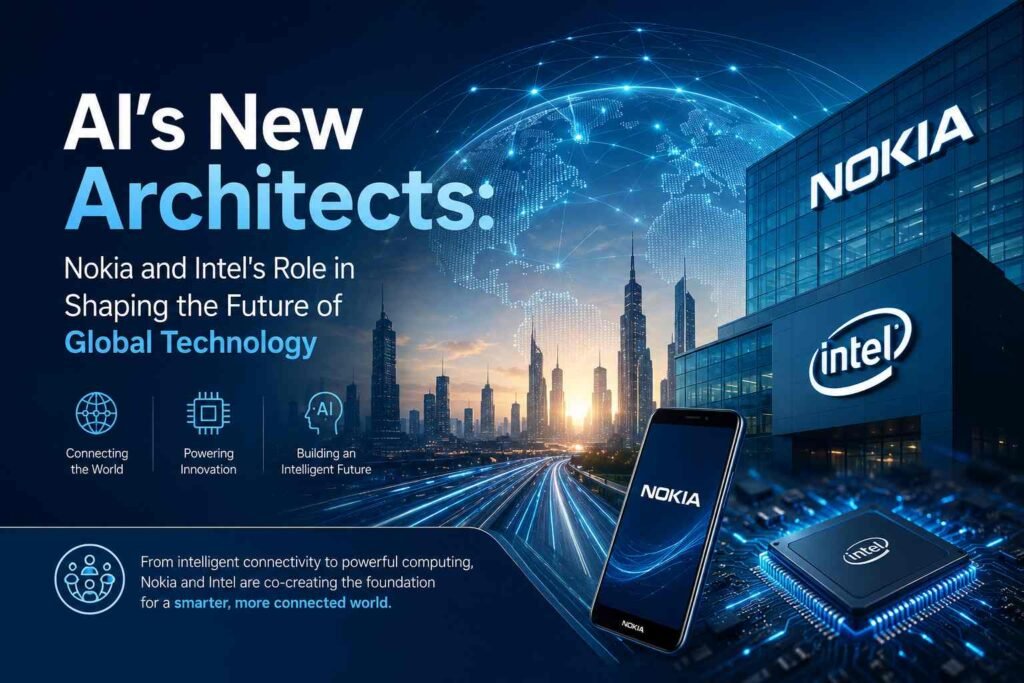
Nokia and Intel are two former telecommunications and microprocessor leading manufacturers, who, after having gone through a significant shift from a historical to a more futuristic business strategy, are today positioned at the center of the infrastructure, enablement, and redeployment of enterprise capabilities as part of the AI revolution.
This article will examine the overall corporate strategies used by Nokia and Intel as leading sponsors in the future of the AI ecosystem from their perspectives in 2026, including what they created from a technology roadmap or platform perspective, what innovations they have made to continue to evolve their value proposition, and key business partnerships, as well as the vision for how these organizations will shape the future of artificial intelligence.
The Background: Why Legacy Technology Giants Are Rising Again
Pure Software AI Technology Will Have Its Limits
In the early 2020s, most advances in the technology being developed to support purposed artificial intelligence were made possible because of advanced software capabilities such as advanced language model development, better neural architecture and more efficient data scaling; however, as the complexity of artificial intelligence grew, so did the number of limitations of developing pure software-based systems, including:
a) Compute bottlenecks;
b) Inefficiencies associated with energy use of the data center(s);
c) Latency issues associated with network connectivity; and
d) Data sovereignty issues related to where global organizations store, manage, and protect company information that could be used to create improved business processes.
The shift towards data-centric AI has resulted in significant changes within the Telecommunications sector.
The Focus on Infrastructure and Hardware
In 2026, AI is not confined to just centralised Data Centres, but rather is distributed across all sectors including:
- Edge Devices
- Telecom Networks
- Autonomous Systems
- Industrial IoT Networks
This shift has created opportunities for those companies with deep knowledge of hardware and connectivity; in particular Nokia and Intel are well positioned to take advantage of this opportunity.
Nokia: From Global Consumer Electronics Leader to AI Infrastructure Leader
Nokia was for many years a formidable global player in the consumer electronics space. That said, those days are well and truly over, and Nokia has now become a critical provider of next-generation telecom network infrastructures. Nokia’s focus on 5G and 6G has created the platform for its subsequent growth through the delivery of AI-based solutions to the marketplace.
AI Native Networks
Nokia’s most important contribution to the AI revolution is its development of AI-native network architectures. These are networks where Machine Learning is embedded into the core of the telecoms networks.
Key capabilities of AI-based network architectures
- Self-optimising networks that dynamically adjust data traffic or workload in real time
- Predictive Maintenance using AI analytics
- Automated network slicing to enable use cases for enterprises
These capabilities provide Telecom Operators with faster, more reliable, and more intelligent ways to deliver connectivity to customers.
Edge AI And Distributed Intelligence
For many years one of NOKIA’s strategic pillars has been focusing Upon edge Artificial intelligence through processing data as near to Its origin point as feasible — Rather than relying exclusively on large centralised public cloud computing infrastructure.
Why is Edge A! Important?
Less Latency for Real-time Applications
More Privacy & Data Control
Less Bandwidth Usage
Edge Platforms at NOKIA are providing the ability for A1 capabilities across industries such as healthcare, manufacturing & cities to deploy AI at -scale -without having to depend solely on Hyperscale Public Cloud Providers.
Partnerships
NOKIA has built long-lasting relationships with large companies in all of the major industries — including Cloud service providers, Government entities across global Governments as well as Private Sector companies To accelerate the deployment of their intelligent network infrastructure (AI-enabled networks) across the globe.
Intel’s Transformational Journey -A Major Tech Turnaround
How They Successfully Reinvigorated Their Business After A 10-year Period Of Difficulties
Intel began 2020 competing against AMD & ARM-based chip manufacturers and in addition many of Its manufacturing processes were running late which raised serious questions about Its long-term future.
However, By 2026 Intel has successfully undergone one of the most amazing “turnarounds” in modern technology history.
Focus On AI For The Future of Computing
The rise of Intel is being driven by “Intelligent Hardware.” They are no longer “Just a] general-purpose processors” but instead they are developing an entire new portfolio of products solely focusing upon advanced processors (accelerators) for Artificial Intelligence.
Innovations in Products
NPU (Neural Processing Unit), AI optimized GPU and custom silicon for enterprises doing AI
These chips are developed and produced to support the specific needs of Modern AI systems – including support for both large model training and real-time model inference.
Expansion of Foundries and Leadership in Manufacturing
Through investments in advanced semiconductor manufacturing, Intel continues to return to being the global leader.
Strategic Development
Creation of next-generation process nodes, expansion for foundry resources to a variety of customers via partnership and geographical diversity to increase overall supply chain resilience.
All of these factors allow Intel to continue to lead as a global supplier of hardware that enables AI.
Integration of Software and the Ecosystem of Software
In addition to hardware, Intel has made significant investments in the development of robust software ecosystems.
Areas of Notable Investment
Frameworks for the AI development, optimization of machine learning workloads and certifications through Open Source.
By bridging the divide between H/W and S/W, provides developers the opportunity to realize the full potential of Intel Technologies.
Bridging the Divide: Where Nokia Meets Intel
AI at the Edge
The Collaboration between Nokia and Intel demonstrates a significant industry trend – a convergence of computing and connecting capabilities.
The convergence of Nokia’s edge infrastructure and Intel’s AI processors provides an integrated, powerful distributed system for the following benefits:
Real-time analytics
Make autonomous decisions
Ability to scale AI across multiple industries.
The Future of Connectivity and the Role of 6G
6G is emerging as the optimal connectivity solution to help the world become a connected society by leveraging ultra-high speeds and high levels of reliability.
There are two companies that are helping to develop 6G; Nokia leading the way in defining the future 6G standards and Intel providing the processing power needed to support this advanced way of connecting people and devices together.
Nokia and Intel are working together to help bring AI (Artificial Intelligence) transformation to industries such as:
Manufacturing
Transportation
Energy Savings
Healthcare
How They Compete Against Big Techs
Big Tech companies such as Amazon, Google, and Microsoft have been the dominant players in the use of cloud-based AI and now, Nokia and Intel have a different vision—moving away from “big cloud” to Decentralized AI Systems—using an infrastructure-first approach and developing solutions designed for Enterprises.
Nokia and Intel have differentiated themselves from big tech by leveraging:
Strong hardware knowledge base
Global infrastructure network
Long-standing relationships with government and enterprises
Thus, Nokia and Intel are viewed as the “go-to” partners for governments and enterprises seeking to develop national and industrial AI capabilities.
Their Challenges and Risks
Growing Competitive Environment
Nokia and Intel are in a fierce competition to continue leading the development of AI technologies against:
Other Semiconductor Companies trying to push the boundaries of innovation
Telecommunications Vendors competing with each other for 5G and 6G services
AI Startups attempting to disrupt the traditional business models
Executing the Transformation
Transforming legacy companies into AI leaders is a difficult task and involves:
Changes in Organization Structure
Finding the Right Talent
Staying Competitive in making Rapid Technological Changes
Geopolitical Dynamics
Geopolitical factors increasingly influence AI and semiconductor technologies; thus, there is a growing need for both Nokia and Intel to navigate these complexities.
The Overall Impact on AI Ecosystem
Democratizing AI Infrastructure
The combined focus on infrastructure as well as the edge will allow Nokia and Intel the ability to democratize access to AI, as organizations will no longer require large cloud budgets to deploy advanced AI.
Sovereign AI
Governments and enterprises are placing greater emphasis on data sovereignty, where Nokia and Intel provide the solutions needed for countries to build their own AI capabilities without total reliance on foreign cloud providers.
Sustainability and Efficiency
AI systems consume vast amounts of energy; thus, both companies are investing in more energy-efficient technologies to help mitigate the environmental impact of AI.
Future Outlook
Continued Innovation
Investment in advanced chip architecture, AI-driven networks, quantum computing research, and to grow the ecosystem will continue to be key for both companies, along with collaboration with partners across many industries and geographies.
Long-Term Vision
Both companies have a vision of creating a seamless AI ecosystem whereby:
- Compute is available anywhere,
- Connectivity is intelligent and,
- AI is embedded everywhere.
Nokia and Intel’s Strategic Direction in 2026 is Futuristic and Will Transform How We See Tech
Nokia and Intel have been around long before you were born! They are redefining the way we will view technology’s future by creating new ways to help people communicate, work together and do other things! Both Nokia and Intel will focus on the “foundations” of artificial intelligence (AI); that is, hardware, networking, and infrastructure.
Both companies are innovators in their own rights with years of experience to back up that claim. From this experience, both companies know that technology (like many other areas) runs in cycles; companies that are flexible enough to adapt, be innovative and invest in themselves can come back from hard times.
Nokia and Intel will not just be part of the development of future technology (as AI continues to grow). Both companies will be leaders.