
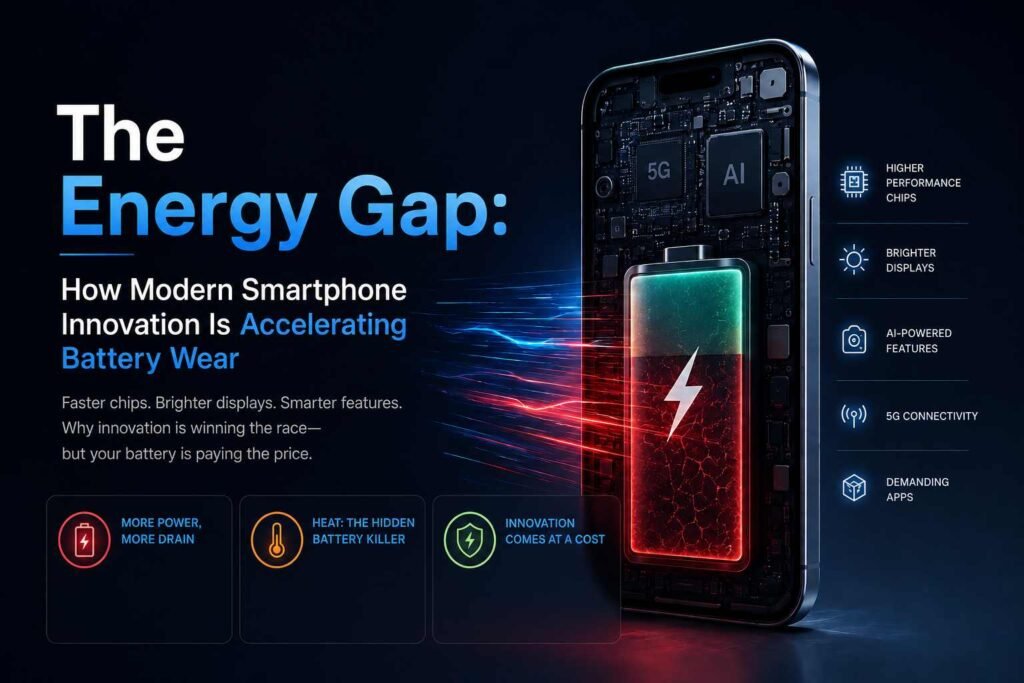
Smartphones are essential to our daily lives and serve as many different types of tools including communication, productivity, entertainment, and health tracking.
By 2026, many smartphone users have started to see an enduring problem in their devices: Battery Health has become worse over the last few years. Devices that used to easily last a whole day can’t even hold a charge for more than 3 hours after only about a year of actual use.
This issue isn’t isolated; it’s been driven by both advances in technology, changes in user behaviors and choices made by the industry when designing smartphones.
While smartphones performance has increased rapidly, battery technology hasn’t kept up with the same speed. Thus, creating an ever-increasing gap between how much energy using smartphone is requiring, versus how much energy it is providing.
This article will review the reasons for the continued rapid deterioration of smartphone battery health in 2026. It will analyze both the technological and behavioral aspects of this deterioration and will provide users with actionable insights that they can use to increase their smartphone’s lifecycle.
The Evolution of Smartphone Power Consumption
The increased level of processing power and the use of AI will contribute to the amount of power smartphones will consume. Smartphones of today are no longer only communication devices; they are now powerful computers and will have very powerful processors that allow them to run many types of artificial intelligence (AI) models right on them. Real-time language translation, AI enhanced photographic output, and prediction of user behavior are just examples of the constant demand that AI puts on a phones power supply.
Power usage for AI-assisted functionality is substantially greater than that of traditional applications since traditional applications only use power when they are open. AI continues to be active, thus using the battery consistently by continuously analyzing data and providing the best performance; this extended usage of the battery increases its usage and resulting deterioration.
High Refresh Rate Displays and Visual Requirements
Some of the biggest contributors to elevating battery consumption levels are high refresh rate displays. High refresh rates of 120Hz – 144Hz will produce much smoother images but consume more power than the traditional 60Hz refresh rate.
In addition, there are many ways these higher quality displays can cause additional higher battery consumption (i.e. high resolution, HDR, always-on displays) resulting in shortened battery life for consumers.
Lithium Ion Battery Technology: An Over Stressed System
Current Battery Chemistry Limitations
Most smartphones in 2026 continue to use lithium ion battery technology. As with any chemistry, lithium ion batteries have their limits. The method of getting power out of these batteries causes them to degrade due to the chemical reaction that occurs when charging/discharging the battery.
The charge capacity of a lithium ion battery continues to decline each time the battery is charged/discharged. Even though manufacturers have developed battery management systems to optimize their function, the chemical composition of the battery will continue to degrade over time which results in the practical experience of being unable to hold a charge as long.
Quicker Charging is Quicker Breakdown of Batteries
Charging via fast charging now is a mainstream trend, and some products have ultra-fast chargers (e.g., charging in less than 30 minutes). Fast charge technology is convenient but generates more heat than a typical charge would produce and increase the stress placed on the electronic components in the device’s battery.
Heat is one of the main factors in a battery losing its charge capacity over time. When a battery is charged frequently using a fast charge method, this results in the chemical components being degraded at an accelerated rate, resulting in the loss of battery life being very noticeable in a short amount of time.
Software Demands and Activities Running in the Background
Always Connected Systems of Devices
As of 2026, smartphones are now embedded into larger ecosystems of devices (i.e., smart homes, smart watches, cloud services), and this constant connection to the internet requires that there are constant data synchronizations, location tracking, and communication to/from multiple networks.
Even when a device is in sleep/idle mode, it will have background applications running (i.e., apps updating, cloud backup procedures, real-time alerts and notifications) that will use energy and contribute to the battery wearing out.
Difficulties with Optimizing Applications
While many applications continue to improve in their optimization of power consumption through coding and application design, applications that consume higher than normal amounts of energy exist due to inefficient coding, too many background activities, and too many system resources being used by the application.
Apps that are very demanding of energy include social networking apps, streaming video apps, and game applications. When these applications are being used simultaneously (multitasking), they have the ability to increase rate of battery degradation significantly.
The Impact of User Behavior
Charging habits are an essential element of how well the battery works over time. An increasing number of individuals are now charging their devices to full charge (100%) or allowing them to drain down to zero (0%) before charging again; both practice can be hard on the battery.
Experts tell consumers that it’s generally best practice for batteries to have a charge level of between 20% and 80% in order to reduce wear and tear on the battery. Despite this guidance, modern day use most frequently see’s consumers charging their mobile device overnight as well as performing top up chargers throughout the day without regard for overall health.
Environmental Factors
Environmental factors such as temperature can have a large impact on the performance of a battery, with excessive heat (such as leaving a device outside in the sun) or high usage (using the device while charging) causing batteries to degrade quicker. Additionally, extreme cold temperatures can decrease performance and thus force users to recharge their batteries too frequently.
The Impact of 5G
One area of consideration in the overall state of battery health is the connection to and need for 5G technology. 5G technology allows for much faster data transfer, however, the amount of energy consumtion needed to maintain a stabe 5G connection is high in comparison to prior generations. Therefore, as users move throughout an area where the signal is weak, the device will continually try to stay connected; this continual fluctuation in network strength will cause the battery to be heavily affected.
Future Connectivity
Future technologies such as 6G and satellite communications are anticipated to require even greater demands to be placed on battery systems than 5G.
Unless major developments in battery technology are made, it’s only going to get worse for the distance between energy use and the energy capacity available to supply that need.
Design Trends Affecting Batteries
Thinner Devices, Less Battery Space
The demand for thinner, lighter smartphones has driven manufacturers to put more focus on design rather than on battery space. As these devices have gotten thinner, they’ve created even less space for larger batteries.
This design limitation causes the batteries to be worked harder to supply energy to more complicated devices, and, in turn, they continue to degrade faster.
Sealed Battery Design, Limited Replacement Options
Most modern smartphones contain sealed batteries that are not designed for easy removal. Although sealed batteries increase both the durability and water resistance of the device, it has added difficulty for users in being able to replace a battery that has degraded.
This causes users to either continue to operate devices with decreased battery capacity or upgrade to new phones sooner than necessary.
Environmental and Economic Impacts
Increased Electronic Waste
Increased battery degradation has resulted in shorter product life cycles, which leads to more frequent upgrades and additional electronic waste. The increase in electronic waste will present a serious issue for the environment.
Batteries contain toxic materials and must be disposed of and recycled properly. If effective recycling systems do not exist, then those materials can cause damage to the environment.
Cost of Ownership
People will incur additional costs resulting from reduced battery performance through either replacing their batteries or by purchasing new devices.
As smartphone usage increases we end up paying more over time for the cost of owning a smartphone.
How to enhance your smartphone’s battery performance
Charge the phone in an optimal way
- Do not always charge the phone fully to 100 percent.
- Keep battery level between 20 and 80 percent.
- Use regular charging as opposed to fast charging whenever possible.
Keep your phone cool
- Do not use the phone while it is charging.
- Do not expose the phone to direct sunlight.
- If the phone is hot remove any protective case from it.
Limit background activity on the phone
- Turn off apps or notifications that you don’t use.
- Limit the amount of apps that refresh in the background.
- Use power saving mode when appropriate.
Make sure to regular update your phone software
Many manufacturers release regular manufacturer software updates to improve your battery’s energy efficiency, so be sure to regularly check for these updates and update your phone to maintain maximum battery life performance.
Bright future of battery technology
Solid state battery technology
One area of research that may significantly advance battery technology is the development of solid state batteries. These types of batteries may have several advantages over lithium ion batteries such as higher energy density and better safety.
Though this battery technology is still being developed, the benefits of solid state batteries will include much longer battery life (by reducing battery degradation).
Artificial intelligence based battery management
Another area of research involves smart algorithms using artificial intelligence (AI) to help with battery usage. These smart algorithms will monitor users to learn how they use their smartphones to optimally reduce battery life use and limit unnecessary strain on the battery.
Closing Statement
Smartphone battery power was severely depleted by 2026 due to many factors (increased processing power requirements, higher-speed connectivity, user actions), but also by limits of the current battery technologies. Thus, new technologies must be created to produce batteries with greater performance and efficiency.
If we want to maintain the life of our battery, we need to understand the above stated factors so we can begin to take action to preserve the batteries in all smartphones. To meet the increasing requirements of the smartphone industry, battery manufacturers must invest in new, modern battery technologies.
To ensure that smartphones have adequate battery power, both future technological innovations are required as well as the change in behavior of users to reflect the realities of the new way we will consume energy.