
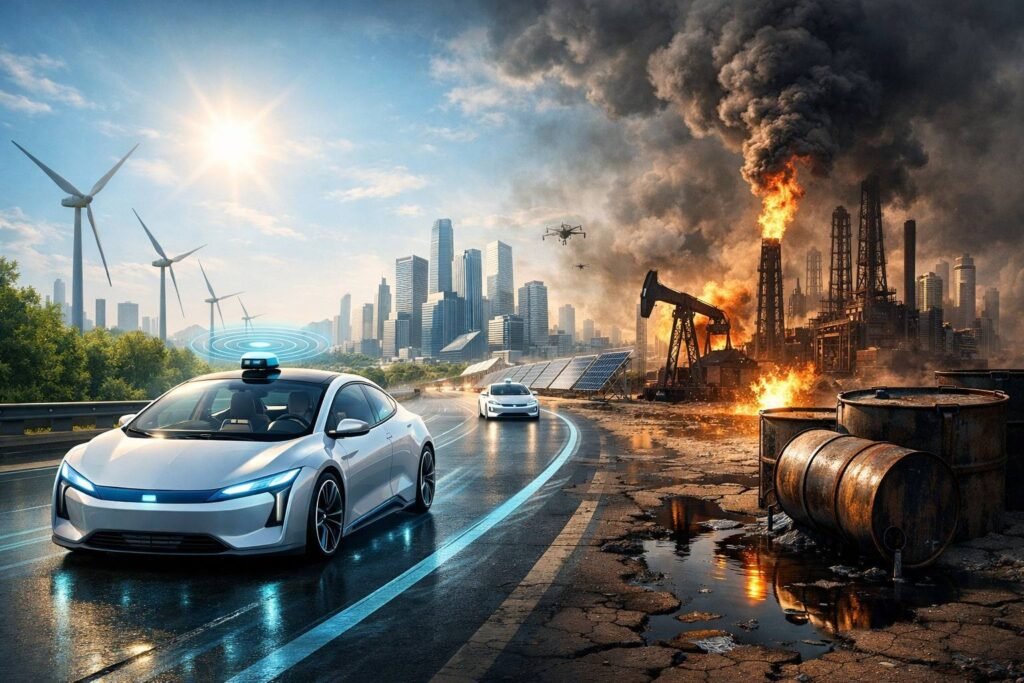
From Oil Dependency to Autonomous
Introduction
The global transportation system is in a period of major change, affected by two factors that are coming together—a shift to autonomous electric vehicles (EVs) and repeated crises in the availability and cost of oil. The historical results of disruptions in the supply of oil and/or large increases in price from 1970 through today all have had significant effects on the economies of countries, geopolitical power dynamics, and the pace and direction of technological change. The introduction of driverless electric vehicles is, therefore, both a technological change and potentially a structural movement away from dependence on fossil fuels.
The existing geopolitical situation and issues with oil supplies caused by global conflict again demonstrate the vulnerability of relying on fossil fuels. Meanwhile, the continuing improvement of artificial intelligence (AI), the technology and price of batteries, and the cost of renewable energy will continue to move self-driving electric vehicles closer to regular usage. This article will discuss the future of self-driving vehicles based on current and anticipated oil-related crises.
The Oil Crisis as a Catalyst for Change
Historically, oil crises have been the catalyst for new ways to get from point A to point B; this is again true today. Current problems with the supply chain of oil due to conflicts in the Middle East have resulted in increased prices, leading consumers and governments to look for alternatives.
As gasoline prices rise in many parts of the world, electric vehicles (EVs) have become increasingly economical because of their lower operational and maintenance costs. Once fuel prices exceed certain points, it typically costs less to own an EV than a gasoline-powered vehicle.
In addition, oil dependence places a nation at economic and geopolitical risk. A key factor in the creation of energy insecurity is the amount of oil road transportation uses.
Accelerating the Shift Away from Oil
EVs have already reduced the amount of oil consumed globally. Each EV replaces a gasoline engine that consumes a large volume of oil each year.
As EVs become more prevalent, the impact on oil consumption increases. Analysts believe that widespread adoption of EVs may lead to a significant reduction in global oil consumption, which may spur long-lasting, structural changes to global energy markets.
The oil crisis is not providing a boost to the fossil fuel system (as has occurred in the past crises), but is instead serving to hasten the transition away from fossil fuels.
The Emergence of Autonomous Electric Vehicles
The Intersection of Two Technologies
Self-driving and battery-powered propulsion technologies are evolving simultaneously and increasingly overlap. The majority of large automakers are investing heavily in both types of technology, aware of the disruptive potential of the two together.
Electric vehicles make it possible to construct mechanical systems that are easier to combine with the automation of vehicles. At the same time, automation can improve the fuel efficiency of vehicles, reduce traffic accidents, and create completely new mobility solutions such as taxi services run by robot-operated vehicles.
Some experts believe that within the next ten years, there will be large numbers of automated cars (self-driving vehicles) used on highways in many parts of the world.
Gain Efficiency and Reduce Dependency on Oil
Automated driving offers significant opportunities for decreasing energy consumption because of:
Improved driving patterns using coordinated systems
Reduced congestion from volume or traffic flow by using multiple vehicles in a coordinated manner
Less weight of vehicles due to increased safety features in automated vehicles.
All of these benefits will assist in decreasing the amount of energy used in the operation of electric vehicles.
At present, if we took all of the electronic cars that are on the road today and made them automated so that they can operate by themselves, there would be a dramatic reduction in oil consumption worldwide.
Creating Opportunities During an Oil Crisis
Financial Value Advantages of Electric Vehicles in an Oil Crisis.
In oil crises, the best reason to own the electric vehicle is its stable price. Oil prices are many times higher than electricity prices which are generally very stable and getting more and more tied to renewable forms of energy that are found within many of the countries using electricity.
Research indicates that the price of gasoline or petrol cars increases significantly during energy crises compared to the cost of an electric vehicle, and as such, consumers will be much less susceptible to price increases associated with the use of gasoline.
Self-driving electric vehicles are likely to provide growth opportunities via implementation of mobile shared-mobility services, which will decrease the amount of time individuals own personal automobiles, and therefore decrease the overall cost of individual transportation.
Energy Independence & National Security
By investing in the development and use of electric and autonomous vehicle technologies, countries can decrease their level of dependence on foreign oil. This, in turn, will lead to improved national security through increased energy independence and lower susceptibility to geopolitical instability.
For those countries with access to large quantities of renewable energy sources (such as solar or wind), electric and autonomous vehicles can potentially be integrated into their domestic energy systems, creating more robust and resilient energy infrastructure.
Integration of Smart Grid and Smart Energy Systems
Most experts believe future autonomous electric vehicles will play an important role in the development of smart grids. Vehicle-to-Grid (V2G) technology enables autonomous vehicles to store energy and transfer energy back to the grid at times of peak energy demand.
The ability to provide energy back to the grid during times of peak demand will help stabilize an electric power grid during emergency situations and can convert autonomous vehicles into mobile energy turbines instead of just being standalone consumers of energy.
Challenges & Limitations to Self-Driving Electric Vehicles
While electric and autonomous vehicles have tremendous potential, there are many challenges that must be overcome before widespread adoption of these technologies occurs. One major challenge for self-driving electric vehicles is the lack of sufficient supporting infrastructure.
Most locations do not have adequate charging stations to support the widespread use of electric and autonomous vehicles. Consequently, electric vehicles will only be adopted if charging stations are readily available, even if fuel prices do not change.
Price of EVs Today
Prices of Electric Vehicles (EVs) have gone down, however, the price to purchase the EV is still an obstacle for a lot of people. The price of autonomous technology (self-driving EVs) makes them even more of a financial burden for most consumers right now.
Over time, as production of batteries increases and the price of batteries drop, the overall price to purchase or own a self-driving EV will also decrease.
Roadblocks to Getting an Autonomous EV on the Roads
Self-driving EVs come with many legal and moral issues such as who is liable in the event of an accident, how do we regulate AI, etc. The problem is that most countries don’t have laws in place to define how this works, so it’s slowing down the ability to implement autonomous EVs to a greater degree.
Predicted Increase in Energy Demand
Even though self-driving EVs are more efficient on a one-to-one basis, with self-driving EVs becoming easier to commute and get from place to place, it is possible that people may use self-driving EVs to increase their travels.
Further research shows that if all of these factors come together, the energy consumed from autonomous EVs could actually increase overall energy usage if not properly controlled.
The Path Forward
What to Expect in the Next 5 to 10 years
In the near future, the price of oil may increase dramatically and lead to a spike in new electric vehicle sales, (even though the self-driving feature will still be limited). Because of this continuous unpredictable oil scenario, local/state/federal government will put together incentives to purchase/own an EV, expand EV charging stations and put more restrictions in place to reduce emissions.
Hybrid technologies that combine partial self-driving and electric vehicle (EV) capabilities should be the primary focus during this transition period.
Medium-Term Outlook (10-20 Years)
Self-driving capabilities will improve and be available to a larger segment of the population as the technology matures and the cost of self-driving EVs continues to decline.
We expect that by this time, private vehicle ownership may begin to decline due to the introduction of autonomous vehicle (AV) fleets, and oil consumption will decrease significantly due to the use of AV fleets in urban areas.
Long-Term Outlook (beyond 20 years)
Electric vehicles and self-driving vehicle technologies could dramatically change transportation systems into:
The near elimination of oil consumption in road transport
The development of fully integrated smart mobility networks
A dramatic reduction in greenhouse gas emissions
This change will also disrupt the oil industry worldwide and force the industry to adapt or go into decline as demand for oil decreases.
Final Thought
Self-driving Electric Cars and Future Oil Prices
The future of autonomous (self-driving) electric vehicles and their technology will rely heavily on oil market developments. Many oil price uncertainties today provide a favorable climate for electro-mobility; therefore, as oil prices rise after a price collapse or peak oil supply, it will expedite a planned transition toward electric & autonomous (self-driving) vehicles. The dependency on oil (literally, and the related price volatility) will then be complemented by electric and automated (self-driving) vehicle technology.
Self-driving electric vehicle technology addresses a number of the challenges related to the use of fossil fuels as transportation fuel: price volatility, energy risk, and environmental degradation. However, various impediments need to be eliminated before self-driving electric vehicles can be successfully employed: infrastructure limitations, regulatory restrictions, and cost issues.
Ultimately, these technological advancements represent not just advancements in transportation; they also represent a potential societal paradigm shift in producing, distributing, and consuming energy. Given the rising incidence of oil price shocks due to oil supply uncertainties, autonomous (self-driving) electric vehicles are a priority for achieving a more resilient and sustainable future.