
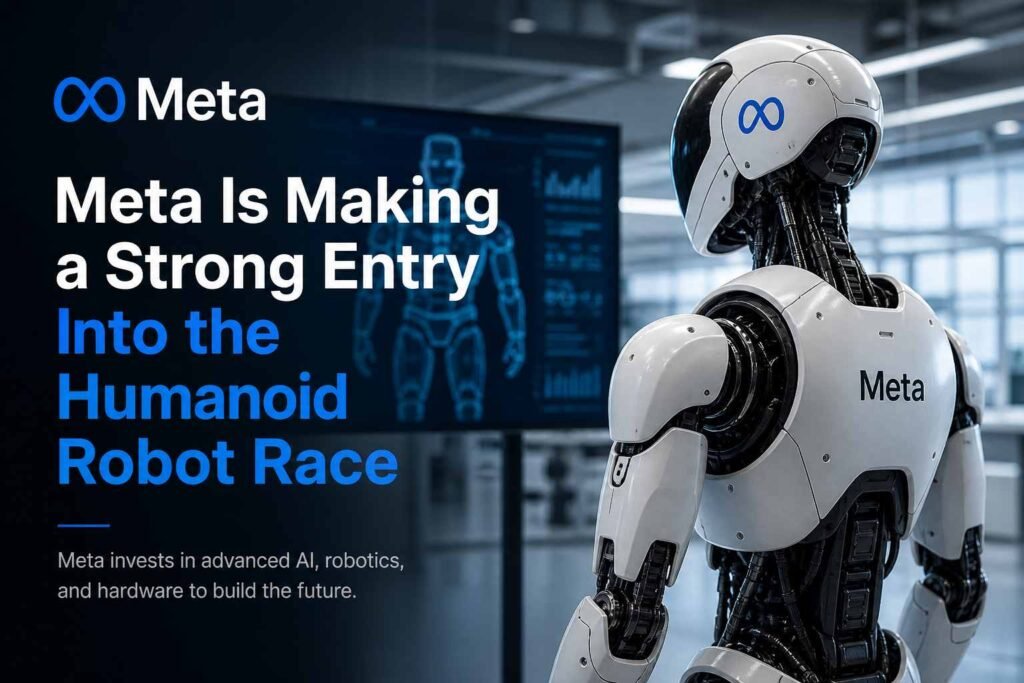
The global competition for creating intelligent humanoid robots is at the fastest rate ever. What used to be thought of as science fiction has now become one of the most competitive arenas for both artificial intelligence and advanced robotics. Many corporations, small businesses, and research companies have invested billions of dollars into building and developing machines that can do things like a person would do, or things that are done by humans, in environments similar to those of humans.
One of the newest and most high-profile players in this highly competitive market is Meta Platforms (the new name/service of Facebook, Inc.). In 2026, Meta made a major strategic decision to get into the humanoid robot business – a choice that will not only change Meta’s future but could also impact how the entire AI industry looks to the future of artificial intelligence.
This article will examine Meta’s entry into the humanoid robot industry, why they made that decision, technology that gives Meta some capabilities to be successful in the industry, where they are most competitively positioned vs. their competitors, and what impact this has on society and the economy as a whole.
Artificial Intelligence’s Humanoid Robot Industry
A Novel Technological Frontier
Humanoid robots are machines designed to look like and move and behave like human beings and, as such, have now emerged as a primary focus for innovation.
Humanoid robots are designed to work in human-oriented spaces, meaning they can perform work in various industries, including homes, factories, healthcare, and logistics.
The rapid growth of humanoid robotics can be attributed to advances in:
- Artificial Intelligence (AI)
- Machine Learning Modeling
- Sensors
- Battery Technology
- Robotics Hardware Design
Organizations like Tesla; startups (Figure AI) and other corporations (1X Technologies) have already developed many humanoid robotic systems capable of completing real-world tasks.
Meanwhile, humanoid robotic systems are being extensively tested in real-world situations such as factory and airport operations, demonstrating the expanding role of humanoid robotic systems in addressing labor shortages and increasing efficiencies.
Meta’s Move Into Robotics
From Social Media To Physical AI
Considering Meta’s long-standing investments (through the FAIR program and Reality Labs) in artificial intelligence, entering into the field of humanoid robotics is not a surprise. These two divisions/initiatives have focused on developing multiple systems that can perceive, understand, and act within the world around them. All of these systems will be key components for what researchers define as “embodied” AIs (also referred to as physical AIs).
However, there appear to be accelerating pressures on Meta to make a more concerted and aggressive entry into the field of physical robotics over the last few months.
The Deal that Changed It All
In May of 2026, Meta purchased the robotics company Assured Robot Intelligence (ARI) a company that creates advanced artificial intelligence (AI) systems for humanoid robots.
There are multiple important reasons for this acquisition:
ARI designs and builds advanced AI systems to help robots understand, predict, and modify human behaviour in complex environments.
The founders and the ARI team will become part of Meta’s internal AI and robotics divisions giving Meta significant expertise in AI and robotics.
This move further aligns with Meta’s strategy to create “superintelligence” systems that can work with both digital and physical worlds.
By acquiring ARI, Meta will move from the research phase of exploring robotics to actively developing robots for the real world.
Why Is Meta Now Competing in Humanoid Robots?
1.The Next Computing Platform
Meta’s CEO, Mark Zuckerberg, has said repeatedly that being early is critical when determining what will be the next major computing platform. Originally, the metaverse was thought to be that new platform. Humanoid robots now provide a more concrete and significant opportunity for Meta to define a new computing platform.
Humanoid robots could potentially serve as:
Personal assistants in your home
Autonomous workers in factories
Service providers in healthcare and retail stores
By investing in the development of autonomous humanoid robots early, Meta hopes to position itself at the core of this new ecosystem.
2.Taking AI To The Real World
Meta has always been focused on providing a virtual experience for its users through various forms of digital connection; however, as AI moves to the next level, there will be new ways for people to use AI beyond the screen.
Embodied AI (or Robots) will be able to:
- Perceive the environment
- Manipulate the environment and objects
- Interact with people in the physical environment
The research Meta has done on tactile sensors, dexterity, and human-robot interaction makes it clear they want to build AI systems that can operate in real-world environments.
3.Competing with Giants
Meta also has a competitive reason for entering the humanoid robotics market; it is a very competitive market with companies like:
- Tesla and its Optimus Robot
- Robotics Startups like Figure AI
- Venture Capital & AI Ldr-backed Startups
Tesla’s humanoid robotics initiative intends to develop robots that can perform daily tasks. If Meta doesn’t get into this market, they will miss out on one of the biggest technology changes in the next 10 years.
Technological Benefits of a Company Such as Meta
Artificial Intelligence Technology and Knowledge
Artificial Intelligence is Meta’s number one asset, given their extensive experience building innovative AI technologies. Some examples include:
Development of very large-scale and sophisticated AI Models; Development of next generation, very refined Recommender Systems; Development of groundbreaking AI R&D in Machine Learning.
All of the above can be adapted to create Robotics in many ways:
Vision-language-action architecture used to create and control robots.
Predictive Analytics that predict human behavior to help control robots.
Utilization of Reinforcement Learning to facilitate robots performing physical tasks.
Open Source Ecosystem
Historically, Meta has been a significant proponent of Open Source software development and has provided tools and frameworks that have accelerated Industry-wide innovation. Using this strategy, Meta can achieve competitive advantage by:
Retaining developers and researchers; Accelerating adoption of Meta’s robotics solutions; Establishing a cohesive and standardised humanoid robotic ecosystem.
Seamless Integration with Existing Value Streams
Meta’s current product categories (AR, VR, and AI) can be used to create seamless user experiences integrating with humanoid robots. Some examples include:
AR glasses could display real-time robot instruction to users using augmented visuals.
AI would be able to control robot functions using voice prompts.
Virtual environments could be used to train robots in performing different tasks.
Issues Facing Meta/Company to Address
1.Complexity of Hardware
The development of robotics requires a higher level of hardware technology and engineering than that of software in order to manufacture a humanoid robot. Examples of this are the following:
Precision Mechanics for the Robot.
Highly sophisticated sensors for the Robot.
High end, durable materials needed to create the robot.
High performance energy systems needed for operation of the robot.
Technological Benefits of a Company Such as Meta
Artificial Intelligence Technology and Knowledge
Artificial Intelligence is Meta’s number one asset, given their extensive experience building innovative AI technologies. Some examples include:
Development of very large-scale and sophisticated AI Models; Development of next generation, very refined Recommender Systems; Development of groundbreaking AI R&D in Machine Learning.
All of the above can be adapted to create Robotics in many ways:
Vision-language-action architecture used to create and control robots.
Predictive Analytics that predict human behavior to help control robots.
Utilization of Reinforcement Learning to facilitate robots performing physical tasks.
Open Source Ecosystem
Historically, Meta has been a significant proponent of Open Source software development and has provided tools and frameworks that have accelerated Industry-wide innovation. Using this strategy, Meta can achieve competitive advantage by:
Retaining developers and researchers; Accelerating adoption of Meta’s robotics solutions; Establishing a cohesive and standardised humanoid robotic ecosystem.
Seamless Integration with Existing Value Streams
Meta’s current product categories (AR, VR, and AI) can be used to create seamless user experiences integrating with humanoid robots. Some examples include:
AR glasses could display real-time robot instruction to users using augmented visuals.
AI would be able to control robot functions using voice prompts.
Virtual environments could be used to train robots in performing different tasks.
Issues Facing Meta/Company to Address
1.Complexity of Hardware
The development of robotics requires a higher level of hardware technology and engineering than that of software in order to manufacture a humanoid robot. Examples of this are the following:
Precision Mechanics for the Robot.
Highly sophisticated sensors for the Robot.
High end, durable materials needed to create the robot.
High performance energy systems needed for operation of the robot.
2.High Expenses
The expense of developing humanoid robots is extremely costly. Due to the extensive amount of AI infrastructure and hardware development, Meta has raised their anticipated total capital expenditures considerably.
Depending on if returns are not immediate, these investments may cause trepidation among investors.
3.Technical Barriers
Although we are witnessing rapid advancements, humanoid robots are currently limited by several technical hurdles including:
Shorter-than-appropriate battery life
Uncertain capabilities to handle erratic and changing environments
Limitations in fine motor skills and dexterity
Experts say there are many robots that struggle executing basic day-to-day tasks in the real world; this signifies the existing disparity between demonstrating a robot’s capabilities and deploying it for actual use.
The Competitive Landscape
An Expanding Ecosystem
The humanoid robot market is becoming more competitive as multiple players have distinct strategies:
Companies have a primary focus on building complete robots from a hardware perspective.
AI-focused startup companies develop the brains of robots (the artificial intelligence).
Other companies utilize a hybrid model with AI and hardware.
Figure AI’s primary focus is building robots with much more streamlined methods of scalable manufacturing as opposed to developing robots with advanced AI capabilities.
Software versus Hardware Strategy
Likely Meta’s strategy centers mostly around the software layer by developing advanced AI models intending to integrate them into the various robotic platforms that will ultimately lead to foundational technology and having diverse partnerships with hardware manufacturers, while also developing ecosystems.
Humanoid Robot Applications
Manufacturing
Humanoid robots are capable of performing frequent and physically taxing jobs in manufacturing plants and considerably lowering labor expenses while increasing productivity.
Healthcare
Humanoid robots may provide assistance with the following tasks:
Monitoring patients
Providing assistance with mobility
Providing assistance with day-to-day caregiving functions
Providing assistance at home
In the future, humanoid robots may provide assistance with:
Cleaning homes
Cooking food
Assisting with daily activities
Logistics and Shipping
According to recent tests at airports, humanoid robots can complete such tasks as:
Handling bags
Moving cargo
Ethical/Social Considerations
Job Loss
A major concern about humanoid robots is the effect on people’s jobs. While robots can increase productivity, they may also replace human jobs in some industries.
Privacy/Security
Humanoid robots that use cameras, sensors and other advanced technology to sense Environmental Data can raise concerns with respect to:
Data Collection
Surveillance
Cybersecurity risk
Human-Robot Communication
A significant issue in developing successful human-humanoid interactions is ensuring the safety of humans interacting with humanoid robots. As such, Meta has funded Research on tactile sensing and human-humanoid Interaction to explore these issues.
Meta’s Future in Robotics
Meta’s Investment in Humanoid Robotics is representative of a long-term vision far exceeding Meta’s current way of doing business. Meta plans to establish itself as an industry leader in:
Artificial Intelligence
Martin J. Walden (Published Date: October 2023)
Artificial Intelligence (AI) is revolutionizing many different fields, but when it comes to applying AI to people’s lives through human-computer interaction (HCI), the possibilities are endless. Here is a list of next-generation computing platforms that will provide enhanced interactivity between humans and machines:
Potential Outcomes
If Meta is successful with its humanoid robot project, it will become a leading company within the robotic industry and open up new avenues for revenue generation (in addition to traditional advertising). By doing so, it will also re-define human-to-technology interaction.
By contrast, if it fails to execute properly, the company will suffer great financial losses, face increasing competitive challenges, and experience setbacks in its strategic direction.
Conclusion
The entry of Meta into the race for humanoid robots is a defining moment in both AI and robotics. The company has acquired the latest innovations in AI and has made a substantial financial commitment to develop and create embodied AI; thus proving its desire and intent to compete at the highest level in one of the most ground-breaking and life-changing industries of the 21st century.
While there are many obstacles that exist for Meta to overcome (e.g., technical limitations and ethical challenges), there are also tremendous opportunities to serve several industries, affect entire economies and forever alter how humans connect with machines.
While Meta is still at the beginning of this journey towards humanoid robotics, it is clear the challenge to dominate the race for humanlike robotics is increasing; therefore, Meta is firmly in contention.